
Ripple fold is the header that made modern drapery look modern. Instead of pleats or rings, a strip of snap tape clips onto carriers spaced evenly along a track, and the fabric is held in a continuous wave that never varies in depth from one end of the run to the other. Ripple fold drapes read as architecture rather than decoration, which is why they show up in hotels, in glass houses, and across the sliders and window walls that Los Angeles builders cannot resist. This page covers how the system works, what it needs from your ceiling, and when a different header would serve you better.
The track is the product
Everything about this header follows from the track, so it is worth understanding first. A ripple fold track is a slim aluminum channel carrying small wheeled carriers, and those carriers are what hold the fabric at fixed intervals. Mounted to the ceiling, the track disappears into the plane above and the fabric appears to emerge from the ceiling itself, which is the effect most people are actually after. Mounted to the wall on brackets, it still works and still waves, though you see a slim horizontal line above the panels. What cannot happen is a decorative rod with rings, because rings slide freely and the wave spacing collapses the instant you draw the panel. If a rod is a requirement of the room, a pleated header is the closer match.
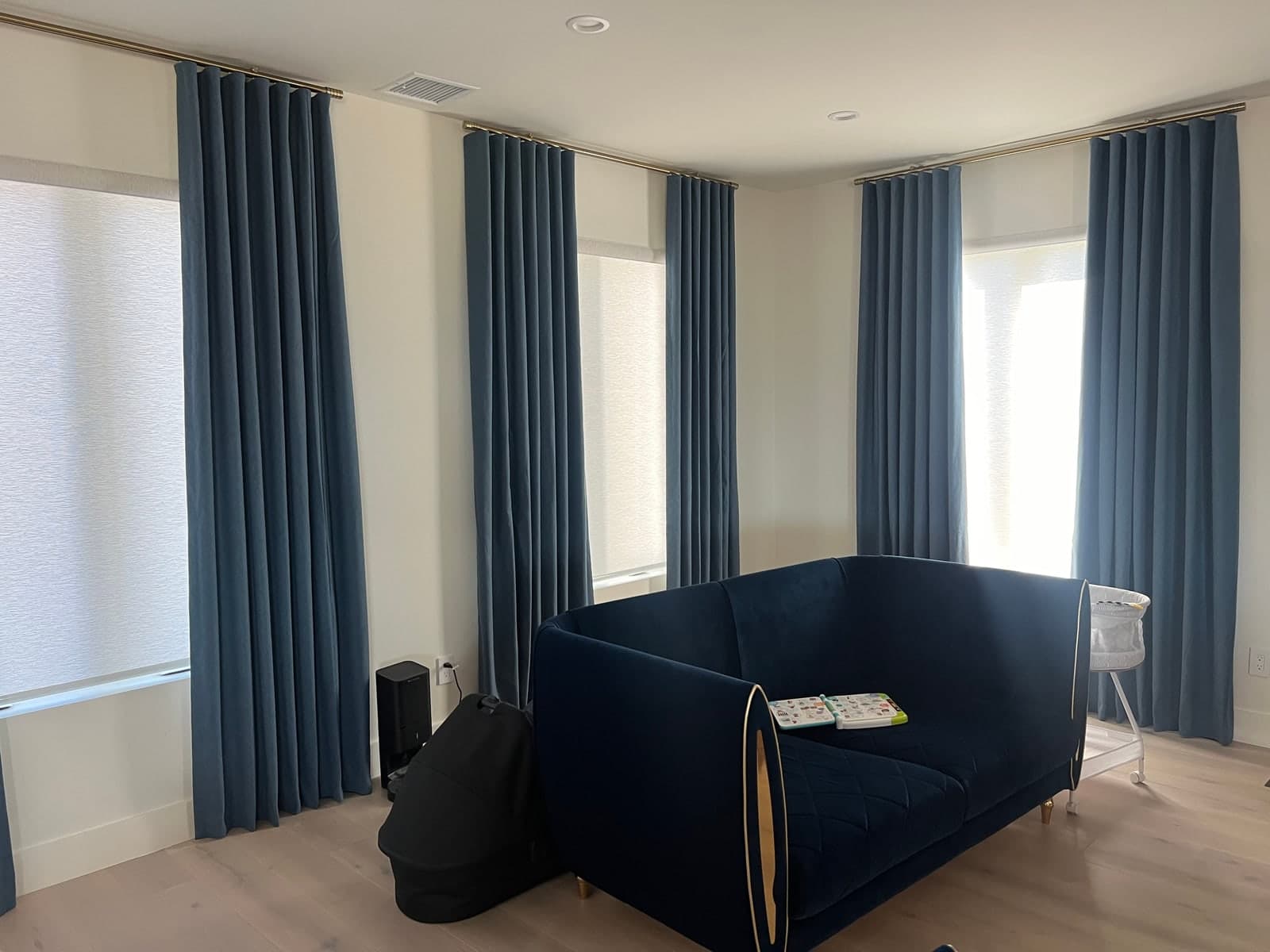
Snap spacing sets the wave
The snap tape sewn into the heading has fasteners at a set interval, and those intervals are matched to the carriers on the track. Closer spacing produces tighter, deeper waves; wider spacing produces a shallower, more relaxed ripple. It is the one aesthetic decision unique to this header, and it is decided at the workroom rather than at the window, which means it has to be right before we cut. We sew at 2.1 times the track width, which is the ratio that fills the standard carrier spacing without crowding, and it is the same figure our window measurement tool uses so the numbers you get there match the numbers we cut to. If you already own a track, tell us the manufacturer and we will match its spacing rather than asking you to replace working hardware.
Predictable stack, and why wide glass needs it
On a 20 foot window wall, the question that matters is not how the curtains look closed. It is how much glass they cover when open. Ripple fold answers that question with a number, because fixed spacing produces a stack of roughly 12 to 16 percent of the track length, every time. We extend the track past the glass by exactly that depth so the open panels park on wall and the view stays whole. Gathered and pleated headers stack less predictably, which on a big span is the difference between a clean reveal and two feet of fabric sitting over the last pane. This is the main reason we specify ripple fold on extra wide windows, sliders, and floor to ceiling glass more often than any other header.
Fabrics that wave well
The header needs fabric with drape and without stiffness. Midweight linens and linen blends are the workroom favorite here, soft enough to fall into the wave and substantial enough to hold it. Sheers on ripple fold are spectacular and one of the best uses of the system, since the regular waves give an open weave the structure it otherwise lacks. Lined midweight goods behave beautifully. What fights the header is anything crisp: heavy interlined drapery, stiff cottons, and anything with a board-like hand will hold angular creases instead of curves, so the run reads faceted rather than fluid. Very heavy velvets can be done, though they want a heavier track and honest talk about weight first.
Where it belongs, and where it doesn't
It belongs on wide spans, on ceiling-height glass, in rooms with clean trim and modern lines, and anywhere the goal is for the fabric to look like part of the building. It is the natural header for the layered sheer-and-blackout setup described on our hotel style curtains page, where two tracks run parallel and each layer waves independently. It does not belong in a room with heavy traditional millwork, where the regularity fights the architecture, and it is a poor fit for a narrow window, since you need enough width for several full waves before the effect registers at all. Below about 40 inches of track, the panel reads as two lonely curves. One recent job that shows the header at its best: a Westside living room with 22 feet of glass and a 10 foot ceiling, a single continuous ceiling track, unlined oatmeal linen sheer on a quiet motor, opening on a schedule at seven each morning.
Motors, cords, and wands
Track systems take motorization more gracefully than any rod, which is a practical argument for this header on tall or wide windows people cannot comfortably reach. A quiet motor at one end of the track draws the panels on a schedule, on a remote, or through a home system, and because the carriers already glide the motor works with the mechanism rather than against it. Cord draw and a simple baton wand are the non-motorized options and both are perfectly good on spans a person can reach. We spec this alongside our other automated work, covered on the drapery in Los Angeles page, and coordinate wiring before drywall on remodels when the timeline allows.
Two ways to get them made
Anywhere in the US: send your track width, the drop, and whether the track is ceiling or wall mounted, plus the manufacturer if you already own one. We confirm the carrier spacing, size the snap tape to match, and review your numbers against photos before cutting; the process lives on the custom made curtains page, and sewing runs 3 to 4 weeks once fabric is confirmed. Panels ship rolled with the tape already sewn in. In Los Angeles and Ventura counties, the measurement, the track installation, and the wave training are all free, which on this header is worth more than it sounds. Stationary versions and single panels are covered on our custom drapery panels page, and the wider casual family sits on the casual and modern drapery page.
Frequently asked questions
What are ripple fold curtains?
Ripple fold curtains hang from a track rather than a rod, and a strip of snap tape sewn into the heading clips onto carriers spaced evenly along that track. Because the spacing is fixed, the fabric is held in a continuous S-shaped wave from one end to the other, with every fold the same depth. There is no pleat, no gathering, and no visible ring. It is the header you see in hotels, modern architecture, and most contemporary retail interiors, which is why people often recognize the look before they know its name.
What is ripple fold drapery?
It is the same thing as ripple fold curtains, and the two names get used interchangeably depending on who is talking. The trade tends to say ripple fold drapery or ripple fold drapes when the panels are lined and floor length, and homeowners tend to say curtains regardless. Some manufacturers and most of the European market call the identical header a wave fold or an S-fold. If you are comparing quotes and one says wave and another says ripple, you are being quoted on the same construction.
Do ripple fold curtains need a track?
Yes, and this is the one non-negotiable thing about this header. The uniform waves exist because carriers hold the fabric at fixed intervals, and only a track provides those carriers. A decorative rod with rings cannot reproduce it, because rings slide freely and the spacing collapses the moment you draw the panel. The track can mount to the ceiling for the cleanest result or to the wall on brackets when the ceiling is not an option, and it can be finished in white, black, or anodized aluminum so it reads as a shadow line rather than hardware.
How much do ripple fold curtains stack back?
Plan on roughly 12 to 16 percent of the track length sitting as stacked fabric when the panels are fully open, so about a foot of stack for every 8 feet of track, split between the two sides on a center-open pair. The great advantage of this header is that the number is predictable, because the fold spacing is fixed rather than left to chance. That lets us extend the track past the glass by exactly the stack depth, so the open panels land on wall instead of covering your view. We calculate it for your specific span before anything is ordered.
How do you install ripple fold curtains?
The track is mounted first, level and anchored into structure rather than drywall alone, since a long span of lined drapery carries real weight. Carriers slide into the track's channel, the panel's snap tape clips onto them one at a time from one end to the other, and end stops and a return carrier finish each side so the fabric wraps back to the wall. Then the waves get trained, which means dressing the folds by hand and letting them set for a few days. It is more involved than hanging a rod, which is why it comes free with every order in LA and Ventura counties.
Is ripple fold the same as wave fold?
Yes. Ripple fold, wave fold, and S-fold all describe a heading carried on track carriers at fixed spacing to produce continuous even waves. Ripple Fold is originally a trade name that became the common term in the American market, while wave is the more usual word in Europe and Australia. There are small differences between manufacturers in snap tape spacing and carrier design, which change how deep the waves read, but the construction and the finished look are the same idea. We will match whichever system your existing track uses if you already have one.