
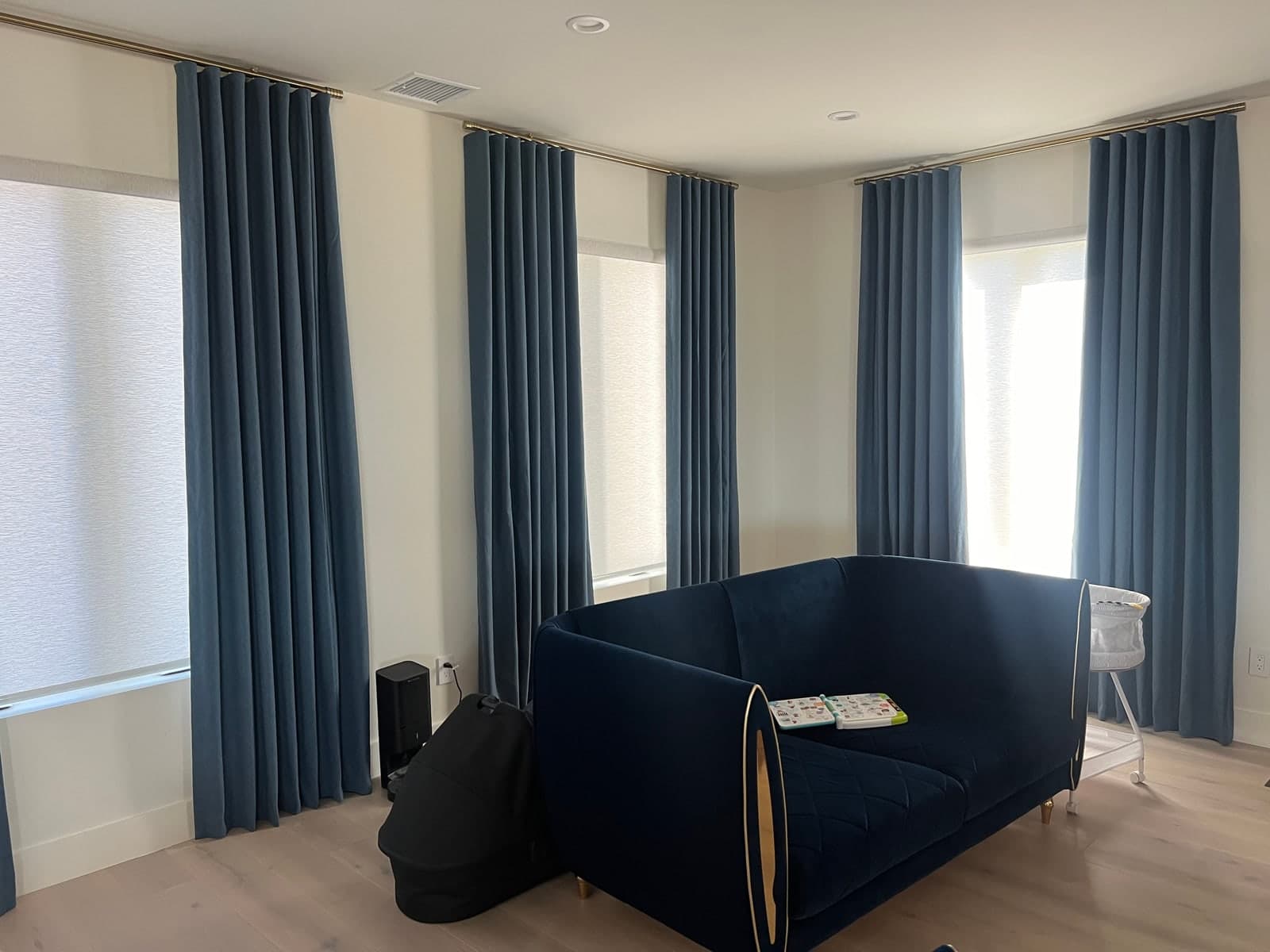
Floor to ceiling curtains are less a product than a decision about proportion. Hang fabric from just under the ceiling to just over the floor and the room reorganizes itself: windows grow, ceilings lift, and walls quiet down. The catch is that the trick only works when the length is exactly right, and "exactly right" is a measurement of your room, not a number on a stock package. That's the entire case for making them custom, and it's the work our made-to-order workroom does daily.
Why stock lengths sabotage the look
Ready-made panels come in 12 inch jumps: 84, 96, 108, occasionally 120. Ceilings don't. An 8 foot 6 room shopping stock sizes chooses between a 96 inch panel hung low (killing the whole point) or a 108 pooling 6 unplanned inches on the floor. The full-height look depends on the rod sitting close to the ceiling and the hem landing deliberately: a half inch float, a kiss, or a chosen break. Deliberate is the word stock sizes can't deliver. We sew to your measured drop, so the hem lands where you decided, not where the factory rounded.
The math at height
Two calculations decide how full-height panels look. Fullness first: rod width times 2x to 2.5x for pleated headers, 2x to 2.2x for ripple fold, 2.5x to 3x for sheers, divided across your panels; skimping reads worse at ceiling height because there's more flat fabric to see. Then the drop: rod position (2 to 4 inches below ceiling or crown) down to the floor, measured at both ends and the middle because buildings settle. Fabrics come 54 inches wide, so tall, wide treatments are seamed from multiple widths with pattern repeats matched; that's workroom labor you never see, and it's why patterned full-height panels quote above plains. The complete walkthrough lives in the measuring guide.
Fabric and lining at full drop
Height amplifies fabric behavior. A linen that drapes charmingly at 84 inches needs proper hemming and sometimes lining at 120 to keep its composure; sheers gain drama with every foot as long as the fullness keeps up; velvets and wools become genuinely architectural, and interlining keeps their long columns still. Lining choices carry more consequence too: an unlined pale fabric at full height is a glowing wall by day, wonderful or washed-out depending on the room, while blackout lining turns the same span into serious light control for bedrooms and screening rooms. Swatches ship free, and we'll talk you out of a fabric that won't survive your drop.
Hardware that carries the height
Full-height panels are heavier and their hardware is less forgiving. Ceiling-mounted tracks give the cleanest full-drop look, especially for ripple fold, and want blocking or the right anchors above. Wall rods near the ceiling need brackets rated for the real fabric weight, with center supports on wide spans so the rod never smiles. And once a span passes ten feet or the rod passes easy reach, motorization stops being a luxury; a full wall of ceiling-height drapery on a quiet motor is the single most-praised thing we install. Hardware guidance ships with every national order, sized to what you bought.
Two ways to get them
Nationwide: measure with the guide, send dimensions and photos, and your panels are sewn in our Los Angeles workroom and shipped rolled, ready to hang, anywhere in the US; the whole process is laid out on the custom made curtains page. In LA and Ventura counties: skip the tape entirely, because measurement and installation are free, and tall work is precisely where professional measuring pays for itself in avoided regret.
Frequently asked questions
Should curtains go floor to ceiling?
In most rooms with standard or tall ceilings, yes: mounting the rod near the ceiling and running fabric the full drop makes windows read taller, ceilings read higher, and walls read calmer, all for the price of longer panels. The exceptions are rooms with radiators, deep sills, or furniture tight to the window, and very tall double-height spaces where full-drop fabric can overwhelm rather than flatter. It's the single best-value proportion trick in drapery, which is why designers default to it.
How long are floor to ceiling curtains?
As long as your room is tall, which is exactly why they're a custom product. An 8 foot ceiling with the rod mounted close to it wants panels around 91 to 95 inches after hem style; 9 foot ceilings want 103 to 107; 10 foot rooms run 115 plus. Stock lengths jump in 12 inch steps (84, 96, 108) and almost never land where your ceiling actually is, leaving hems floating awkwardly or puddling by accident. We sew to the half inch of your measured drop.
How do you measure for floor to ceiling curtains?
Decide the rod position first (typically 2 to 4 inches below the ceiling or crown molding), then measure from where the fabric will hang to the floor at both ends of the window and the middle, because floors are honest about a building's age even when ceilings aren't. Choose the hem: a half inch float for practicality, a kiss for tailoring, a small break for softness. Our measuring guide walks the whole process with diagrams, and your numbers get a human review before we cut.
What fabrics work best at ceiling height?
Weight and stability matter more as the drop grows. Medium-weight linens and linen blends hang beautifully and stay civilized over long drops when properly hemmed; sheers at ceiling height are glorious and want generous fullness to avoid looking stringy; velvets and wools deliver the most dramatic full-height presence and appreciate interlining to keep the columns still. Very lightweight unlined cottons are the one family we caution against at height, since every draft animates them.
Do floor to ceiling curtains make a room look bigger?
Taller, yes, reliably; the vertical lines and raised rod pull the eye up and the ceiling visually follows. Bigger overall depends on color and fullness: panels close to the wall color extend the wall and enlarge the room, while high-contrast panels frame the window and shrink the wall slightly even as they add height. If maximizing apparent size is the goal, go full drop, match the wall's tone, and keep the fullness generous so the fabric reads as architecture rather than clutter.
How much do floor to ceiling curtains cost?
More than standard-length panels, for honest reasons: a ceiling-height drop uses meaningfully more fabric, longer drops often require seaming and always require careful hemming, and the hardware must carry the extra weight across the span. Fabric choice remains the biggest lever, then width and lining. We quote against your exact dimensions before you commit, whether you're shipping nationwide or booking the LA measurement, so the number reflects your room rather than a stock chart.
Can you ship floor to ceiling curtains outside Los Angeles?
Yes; they ship anywhere in the US, rolled rather than folded so they arrive press-ready. You measure with our guide (rod position, drop at three points, width), we confirm the numbers against your photos before cutting, and the panels arrive with hanging guidance written for a person with a drill and a free afternoon. In Los Angeles and Ventura counties the white glove version applies instead: we measure and install free.