
If you searched "drapery" rather than "curtains," you probably speak some of this language already, so this page skips the introductions and gets into construction, fabric sourcing, and how the workroom operates. For the more casual version of the conversation, our custom drapes page and custom curtains page cover the same workroom from the homeowner's side.
What drapery means to us
Drapery is the lined, constructed end of the window treatment spectrum: panels engineered from face fabric, lining, and often interlining, built on a buckram heading, finished with weighted hems, and hung on hardware chosen for the span and the weight. The distinction from "curtains" isn't snobbery; it's a bill of materials. A drapery panel is closer to upholstery than to a ready-made curtain, and everything on this page follows from that.
Construction, layer by layer
The face fabric gets the credit; the layers behind it do the work. Lining protects the face from LA sun, evens out the street-side appearance, and adds the first increment of body. Interlining, a flannel layer between face and lining, adds the second and larger increment: thermal performance, acoustic softening, and the deep, still folds that read as money in photographs. The heading is built on buckram with the pleat style sewn to calculated fullness, and hems finish with corner weights (and covered lead weights in the hem fold where the drop demands it) so panels hang plumb and return to position after every draw. Side hems and bottom hems can be machine-finished or hand-finished; we quote both and recommend per fabric.
Fabric sourcing
We hold accounts with the major mills: Kravet, Schumacher, and Thibaut among them, alongside our own stocked lines of linens, velvets, sheers, and blackout weaves for projects that don't need a mill lead time. Memo samples come to you or your client free. We track dye lots on multi-window orders, confirm repeats before cutting patterned yardage, and welcome COM when the scheme already exists; we'd just rather check your yardage math before you buy the fabric than commiserate after.
Header styles, by the numbers
Pinch pleat (two- and three-finger) at 2x to 2.5x fullness remains the workroom's most-sewn heading: structured, classic, and tolerant of nearly any fabric weight. Ripple fold at 2x to 2.2x runs on track systems, draws beautifully across wide spans, and dominates our contemporary and motorized work. Tailored pleat gives a crisp single fold for modern rooms that find pinch pleat too traditional. Inverted pleat hides the structure entirely for a flat, architectural face. And French pleat, the hand-tacked three-finger classic, is the heading we reach for on interlined silks and formal rooms. All of them are shown with photos on the pleated drapery page and the casual page.
Working with designers
Roughly half the workroom's drapery volume arrives through interior designers, and the process is built for it: trade pricing on every order, a dedicated contact, priority lead times on install dates that protect your project schedule, free memos, COM handling with yardage verification, and site measures coordinated with your GC when the windows aren't cased yet. We're happy working from your drawings and window schedules, and equally happy being invisible to your client. Details and the application live on the trade program page.
Installation, done like it matters
Drapery succeeds or fails at the install. Hardware gets mounted level to the room rather than to a 1930s frame, with anchors matched to plaster, lath, or studs as found. Returns wrap to the wall at the projection the light control demands; French returns curve the panel back cleanly where there's no rod to hide. Ceiling mounts get laser-lined and blocking-checked before anyone drills. Panels arrive rolled, hang immediately, get steamed and fold-trained on site, and hem breaks are verified against the actual floor. All of it is included, free, across Los Angeles and Ventura counties, which remains the least common sentence in this industry.
Recent work
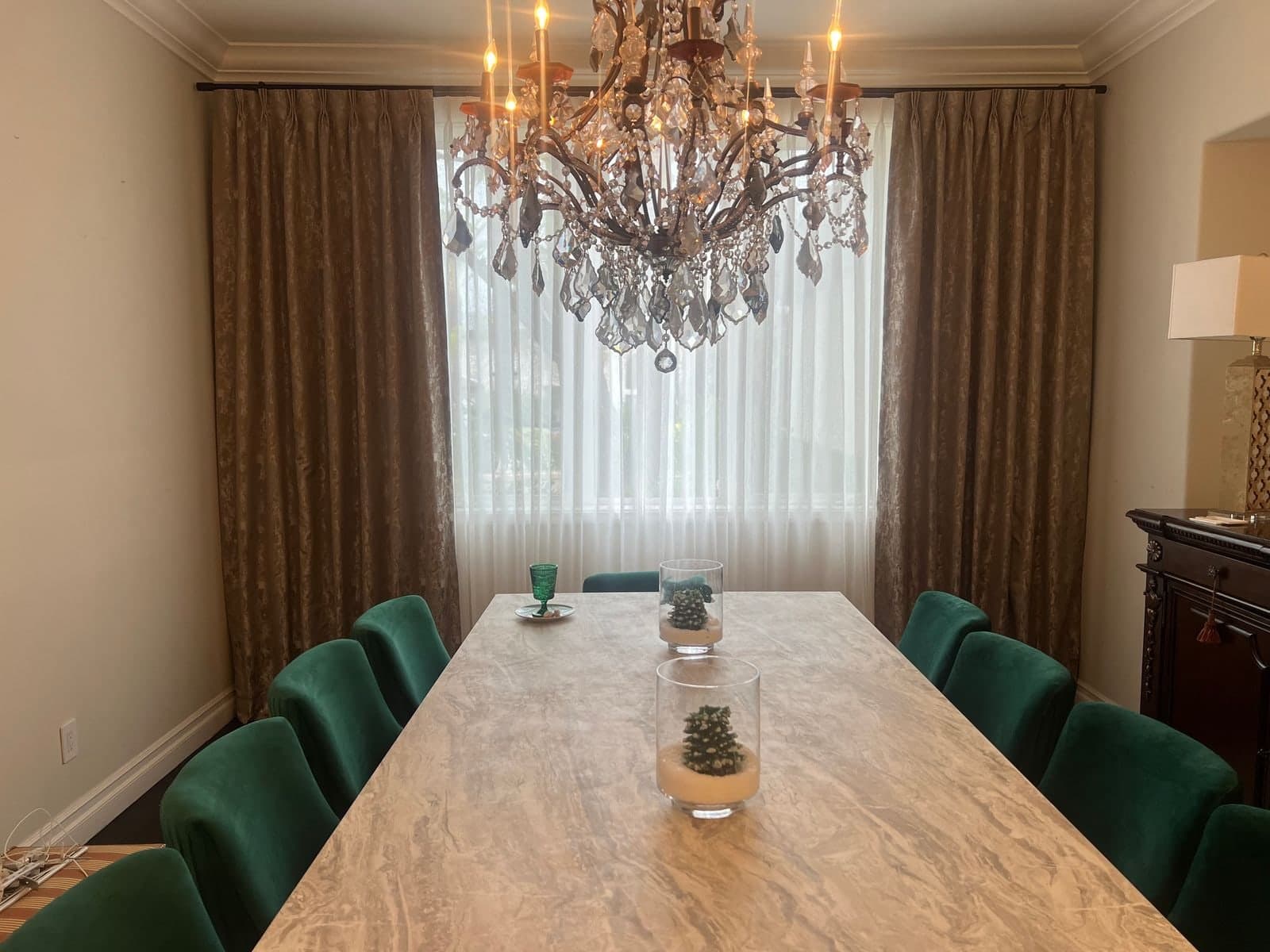
The recent shape of the drapery book: an interlined wool sateen in a Hancock Park dining room, French-pleated, breaking two inches on the original oak. A Bel Air project with a designer: 22 windows of ripple fold in a Schumacher sheer over blackout rollers, ceiling tracks throughout. And a Palisades new build where the drapery package was planned at rough-in with the motorized tracks wired before drywall. Larger context on how we approach the whole category is in the complete LA guide, and finished work is in the gallery.
What real drapery costs in LA
Honest framing, since drapery quotes vary more than any other category we make: the fabric tier sets the floor (stocked workroom lines versus mill fabric versus trade-restricted showpieces), construction sets the middle (lining, interlining, hand-finishing), and size, span, and hardware finish the number. Measurement and installation are included rather than lines on the invoice. The free consultation produces a per-window itemized quote against your actual openings, which is the only drapery number worth comparing.
Frequently asked questions
Do you work with interior designers on drapery projects?
It's a core part of the workroom's business. Designers get trade pricing on every order, a dedicated contact who knows their active projects, priority lead times, and free memo samples. We're equally comfortable being client-facing at the measurement or staying entirely behind your brand; tell us how you run your projects. The trade program details live on our designer discounts page, or just identify yourself as trade at first contact.
How do you handle COM fabric that we specify?
Happily, and with a checkpoint. Send us the window schedule before you order yardage and we'll confirm the fabric quantity, including fullness, repeats, and hem allowances, because COM shortfalls are the most preventable delay in this business. When the fabric arrives we inspect it flat before cutting and flag any flaws or dye-lot issues immediately. If a textile is wrong for drapery weight or drop, we'll say so before a single cut rather than after.
What is the difference between machine-finished and hand-finished drapery?
Where the needle work happens on the finishing details. Machine finishing runs side hems and bottom hems through the machine: fast, consistent, and appropriate for many fabrics and budgets. Hand finishing sews hems and headers by hand with hidden stitches, lets the panel hang with a softer edge, and is the standard for silks, velvets, interlined work, and anywhere the drapery will be examined up close. We quote both and recommend by fabric, not by upsell.
Do you provide interlining?
Yes, and we recommend it more often than clients expect. Interlining, the flannel layer sewn between face fabric and lining, adds body, depth, thermal performance, and the full, upholstered hang that photographs read as luxury. It matters most on silks (which look thin without it), velvets (which gain gravity), and any long drop where you want the folds to stand still. It adds fabric and labor cost, and on the right project it's the difference between nice and finished.
Can you work from a Kravet or Schumacher scheme we've already built?
Yes. We hold accounts with the major mills, so if your scheme specifies Kravet, Schumacher, Thibaut, or their family brands, we order the yardage, confirm dye lots, and sew to your specification. If a fabric is trade-restricted, our account usually covers it. Send the pattern numbers and the window schedule and we'll return yardage requirements and a quote, typically within a couple of business days.
What does the free installation actually include?
A real installation, not a drop-off. The crew mounts hardware level to the room with anchors appropriate to the wall (plaster and lath gets treated differently than drywall), sets returns and overlaps, hangs and dresses the panels, steams out transit creases, and trains the folds. Hem breaks get checked against the actual floor and adjusted on site if needed. We leave when it photographs well, which is a standard designers tend to appreciate.
Do you install existing drapery we already own?
Case by case, honestly. Installation is included with drapery we make, and that's the core of the service. For existing panels, re-hangs and hardware swaps are often something we can fold into a project we're already doing in your home; as a standalone service it depends on scope and schedule. Send photos of the panels and hardware and we'll give you a straight answer rather than a reflexive yes.