
The reason a hotel room feels finished the moment you walk in is mostly the window. Hotel curtains are built as a system: a sheer that glows all day, a lined blackout drape that closes over it at night, both riding a ceiling track in even ripple folds, meeting at the center with an overlap and wrapping back to the wall at the sides so no light sneaks around. None of that is exotic. It's a set of decisions, and we make the same ones for a bedroom in Brentwood or a guest suite in Denver that a hospitality workroom makes for a 300-room property. This page covers what hotel drapes are actually made of, how to get the look at home, and what we do for boutique hotels and rentals that need the real thing in quantity. All of it is sewn to order in our Los Angeles workroom.
The anatomy of a hotel window
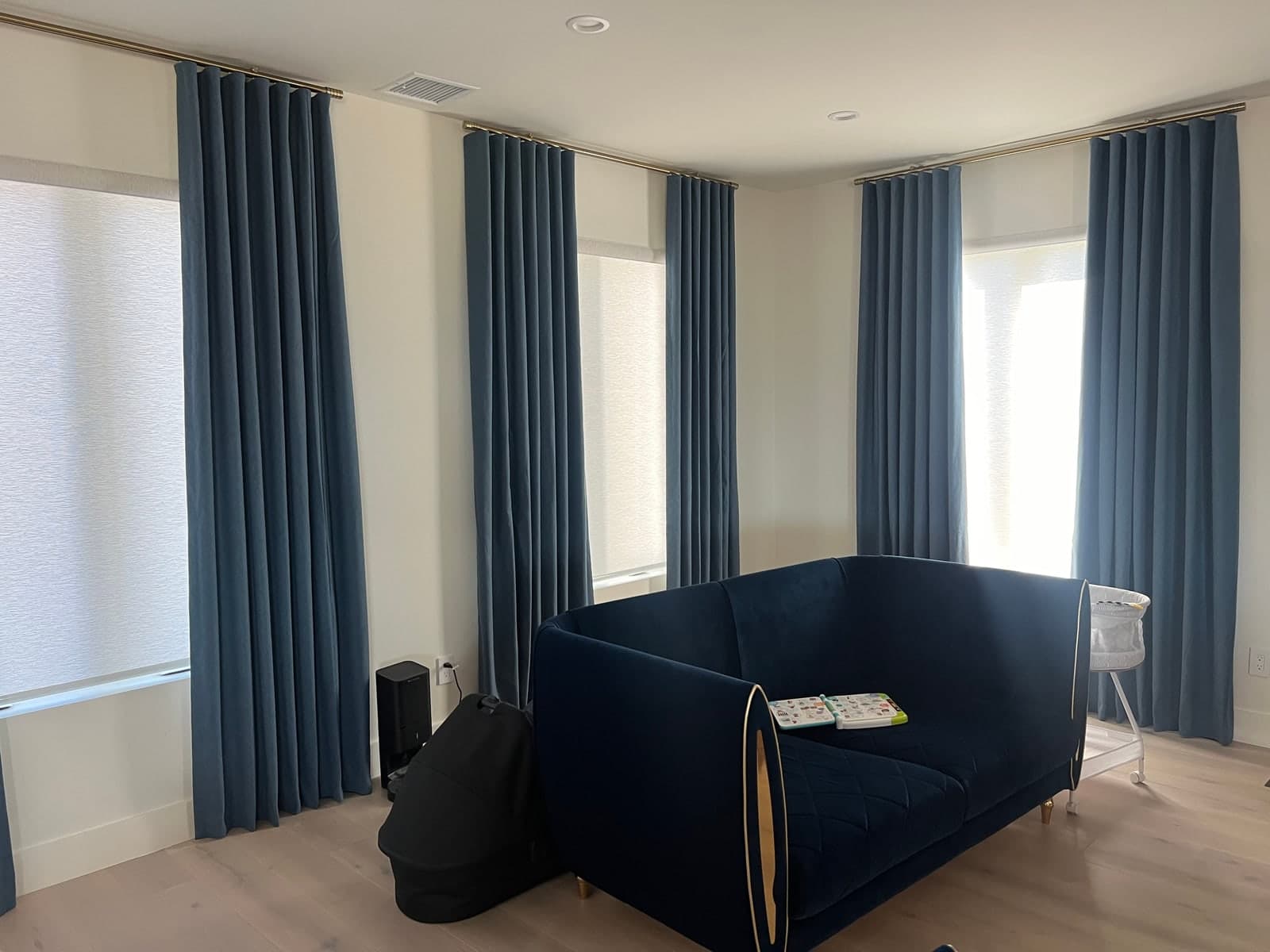
Strip a hotel window down and you'll find five parts. A ceiling-mounted track, usually recessed in a pocket or hidden behind a cornice board, so the drapery appears to fall from the ceiling itself. A ripple fold header on both layers, snap tape on carriers, which makes uniform S-waves that look the same open, closed, and from the parking lot. A sheer layer against the glass, often a wide-width voile that runs across a 12 foot window without a seam. A blackout drape on the outer track, a decorative face fabric with a 3-pass blackout lining sewn behind it. And the details nobody notices until they're missing: a center overlap where the two panels cross by three or four inches, and returns that carry the fabric back to the wall at each end. Take any one away and the room stops feeling like a hotel. Keep all five and it does, in any fabric you like.
Why the track matters more than the fabric
Rods are furniture; tracks are architecture. A rod sits on brackets a few inches off the wall and announces itself with finials. A track disappears into the ceiling, lets the drape run wall to wall without a bracket interrupting the wave, and moves heavy blackout panels with one finger or a motor. That's why hotel drapery is almost never on a rod. For a home, the same logic holds any time the window is wide, the ceiling is tall, or the drape is heavy; the floor to ceiling look is a track look. We install two-channel tracks that carry sheer and blackout on separate runs, cord-free, and we motorize them when the client wants the drapes on a schedule. A motorized blackout that opens at seven and a sheer that closes at four is the hotel experience distilled. If your room has crown molding or a soffit, a track tucks under it where a rod can't.
The blackout layer
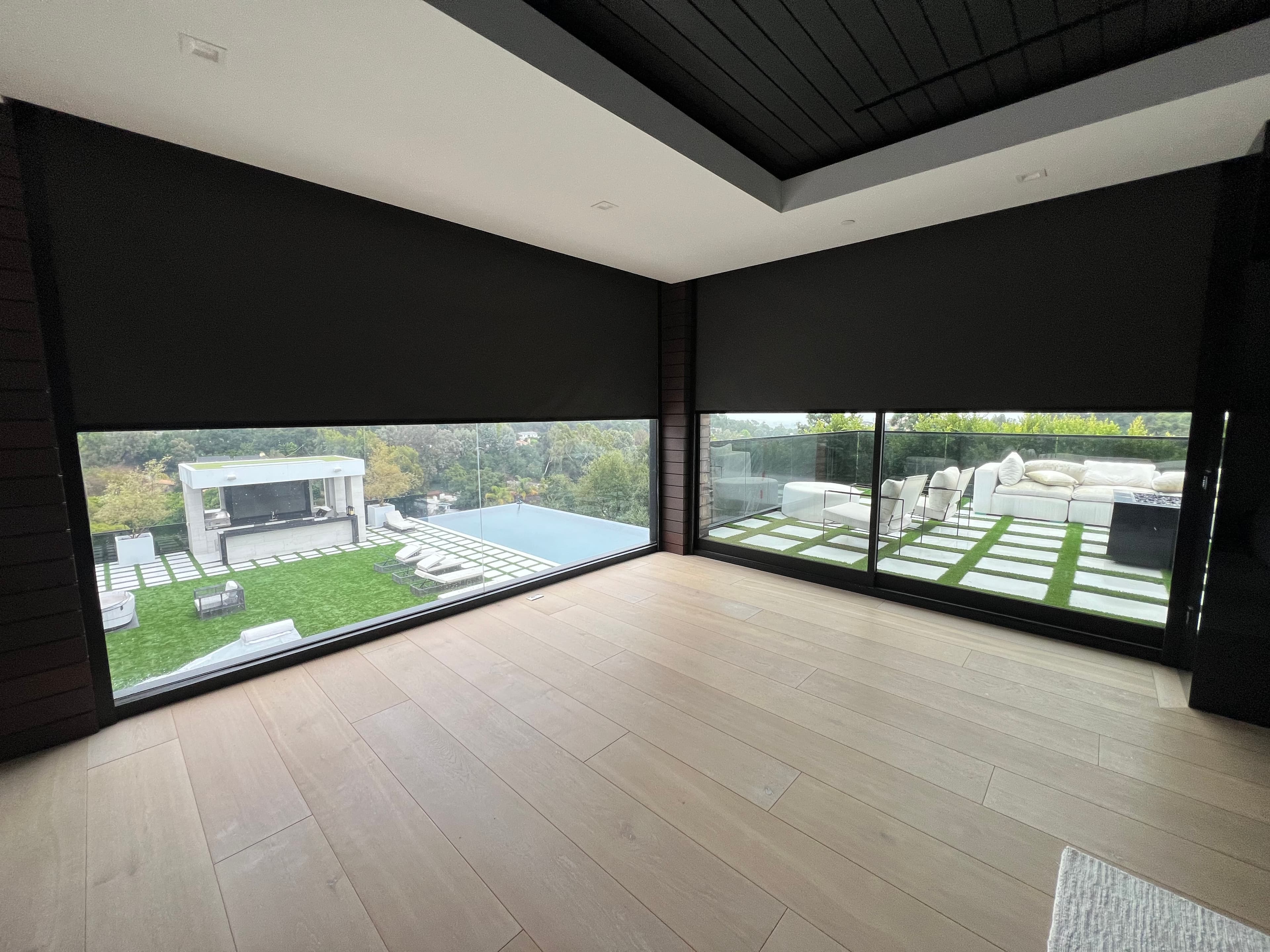
Hotel blackout curtains are dark for two reasons, and the fabric is only one. The lining is a 3-pass blackout, a foam-coated layer that stops light through the panel entirely; hotels use it on every guest room drape because a guest who can't sleep is a review waiting to happen. The other reason is coverage. Hotel drapes run past the window on every side, overlap at the center, and return to the wall, so the light has nowhere to go around. At home, most blackout failures are coverage failures: a beautiful blackout panel that stops at the frame and leaks a bar of morning down each edge. We build the layer the hotel way, with the panel width run through the fullness math for your track, a center overlap sewn in, and returns matched to the track's projection. Our custom blackout curtains page goes deeper on linings and edge control, and for a window that needs darkness without drapery at all, a blackout shade behind the sheer does the same job in less space.
The sheer layer
The sheer is what makes a hotel room feel bright and private at the same time. Hotels use it because it flatters everything: a room at noon with the sheer drawn reads calm instead of glaring, and from the street the window shows a soft glow instead of your furniture. The fabric is typically a polyester voile or a linen-look sheer, chosen for durability and easy laundering, sewn at 2.5x to 3x fullness so it reads as mist rather than mesh. At home we'll often upgrade it to a real linen sheer, which has more texture and a warmer glow, and we'll match the ripple fold spacing to the blackout layer so the two waves line up when both are drawn. The options are on our custom sheer curtains page. Skip the sheer and you have a bedroom that's either wide open or black; keep it and you have every setting in between.
The fabrics hotels use, and what we'd use at home
Hospitality drapery fabrics are chosen for abuse. They're polyester or polyester blends more often than not, inherently flame-resistant to NFPA 701, colorfast under years of sun, and cleanable in place. They can look wonderful; the better hotel groups spend real money on textured weaves and jacquards that read as linen or silk from across the room. For a home, you get to loosen those rules. A midweight linen or a cotton velvet as the blackout layer's face fabric gives the hotel structure with a residential hand. Neutral is the hotel default for good reason, since the drapery has to work with every guest's taste, but a private bedroom can carry color. When a client wants the durability too, we source fire-rated and performance fabrics through the same mills that supply hotels, in weights that hang like the residential ones.
Getting the look at home
A primary bedroom is the obvious candidate: sheer plus blackout on a ceiling track, floor length at a half inch float, wall to wall if the window is the only thing on that wall. Guest rooms and kids' rooms take the same build with a simpler face fabric. Media rooms usually skip the sheer and run a heavier blackout drape, sometimes velvet, on a motorized track. Short-term rentals are where the hotel build makes the most business sense, because guests judge sleep first, and a listing with real blackout and a soft daytime sheer photographs and reviews better; we've sewn matching sets for multi-unit owners who wanted every bedroom identical and easy to replace. Whatever the room, the numbers come first: track length, fullness, drop to the floor, overlap, return. Our free curtain length calculator settles the rod height and drop, the measurement tool does the rest, and in LA and Ventura counties we'll measure for free.
For hotels, rentals, and designers
We sew for hospitality as well as homes. Boutique hotels, inns, and multi-unit rental owners get the same workroom construction in production quantities, with fire-rated fabrics where the code requires it, identical panels across rooms, spare panels sewn from the same dye lot, and one account manager as the single point of contact. Interior designers and contractors receive trade pricing through our designer discounts program and can specify their own fabric. Lead times for larger runs depend on fabric availability, and we'll tell you honestly what a 20-room order looks like before you commit. Los Angeles and Ventura properties get on-site measurement and installation; everywhere else we work from your drawings and photos and ship in sequence.
A recent order
A four-bedroom short-term rental in Pacific Palisades, all bedrooms identical: ceiling tracks, an ivory linen-look sheer at 3x fullness, and a blackout drape in a warm greige textured polyester with a 3-pass lining, ripple fold on both layers, a four inch center overlap, cut to a float. The owner's reviews had mentioned early light in three of the rooms. The next dozen mentioned the sleep.
Ordering, two ways
Anywhere in the US: measure, send numbers and photos of the wall and ceiling (we need to see what the track will mount to), we review, and the layered set ships in three to four weeks with the track hardware and a hanging guide. In Los Angeles and Ventura counties, the measurement and the installation are free, and for a ceiling track that's the part worth having done.
Frequently asked questions
What kind of curtains do hotels use?
Almost always a two-layer system: a sheer against the glass and a lined blackout drape over it, both in ripple fold on a ceiling-mounted track. The fabrics are usually flame-resistant polyester or blends chosen for years of sun and cleaning, in textured neutrals that read as linen or silk from a distance. The blackout layer carries a 3-pass lining, the panels overlap at the center, and the ends return to the wall. The look comes from the construction, not the fabric, which is why we can build the same system in linen or velvet for a home.
How do hotels get their rooms so dark?
Coverage, more than fabric. The blackout drape has a 3-pass lining that stops light through the panel, but that's the easy part. The drape also runs well past the window on each side, overlaps itself by several inches at the center, returns to the wall at the ends, and hangs from a track tucked against the ceiling, so light has no gap to travel through. Many hotels add a cornice or a ceiling pocket over the track to close the top. At home, copying the coverage matters more than buying a thicker fabric.
How do I get the hotel curtain look at home?
Build the layers. Mount a track at the ceiling, or as close as your crown molding allows, and run it wide of the window. Hang a sheer on the inner channel at 2.5x to 3x fullness and a lined blackout drape on the outer channel at about 2x, both in ripple fold so the waves stay even. Sew in a center overlap and returns at the ends, cut the length to a half inch float, and choose a calm face fabric. Motorize it if the budget allows; a drape that opens itself at seven is half the hotel feeling. We make the whole set to your measurements and ship it, or install it in LA.
Why do hotel curtains overlap in the middle?
To kill the light line. Two panels that simply meet at the center leave a slit that opens every time the fabric moves, and morning finds it. Hotel drapery is built on a track with an overlap arm or a master carrier, so the leading edge of one panel passes three to four inches in front of the other when closed. It's the same reason the panels return to the wall at the ends. We sew the overlap into every layered blackout set we make, and it's a detail most ready-made panels can't offer because they weren't built for a track.
Do hotel curtains need to be fire retardant?
In a hotel, yes. Fire codes in most jurisdictions require drapery in public accommodations to meet NFPA 701 flame-resistance standards, and hospitality fabrics are woven or treated to pass it. In a private home there's no such requirement, and most residential fabrics aren't rated, though inherently flame-resistant polyesters are available if you want them. For rentals the answer depends on how the property is classified locally; we'll help you source rated fabric when it's needed and skip the premium when it isn't.
Do you make curtains for hotels and rentals?
Yes. We sew for boutique hotels, inns, and short-term rental owners as well as private homes, with the same workroom construction in whatever quantity the property needs. That includes fire-rated fabrics where code requires them, identical panels across rooms with spares from the same dye lot, and trade pricing for designers and property managers. Los Angeles and Ventura properties get on-site measurement and installation; elsewhere we work from drawings and photos and ship in sequence. Tell us the room count and the window sizes and we'll quote it honestly.