
Most people shopping for drapery are really shopping for two numbers they've never been told: how many panels this window takes, and how wide each panel has to be. Get those right and almost everything else is taste. Get them wrong and no fabric, lining, or hardware rescues the result, because a panel that's too narrow looks too narrow from the doorway forever. This page is the answer to both questions, and then the panels themselves, cut and sewn to whatever the answer turns out to be for your window.
What a panel actually is
A drapery panel is a single finished piece: one face fabric, one lining if you've chosen one, one header across the top, hems on all four sides. A pair is two of them. The industry counts panels because that's the unit the workroom builds, which is why a quote reads "two panels, 67 inches finished width each" rather than "curtains for the living room." Retail muddies this by selling single panels and pairs under the same photo, and a good share of the disappointment in the category traces back to somebody ordering one of something that needed two.
How many panels your window wants
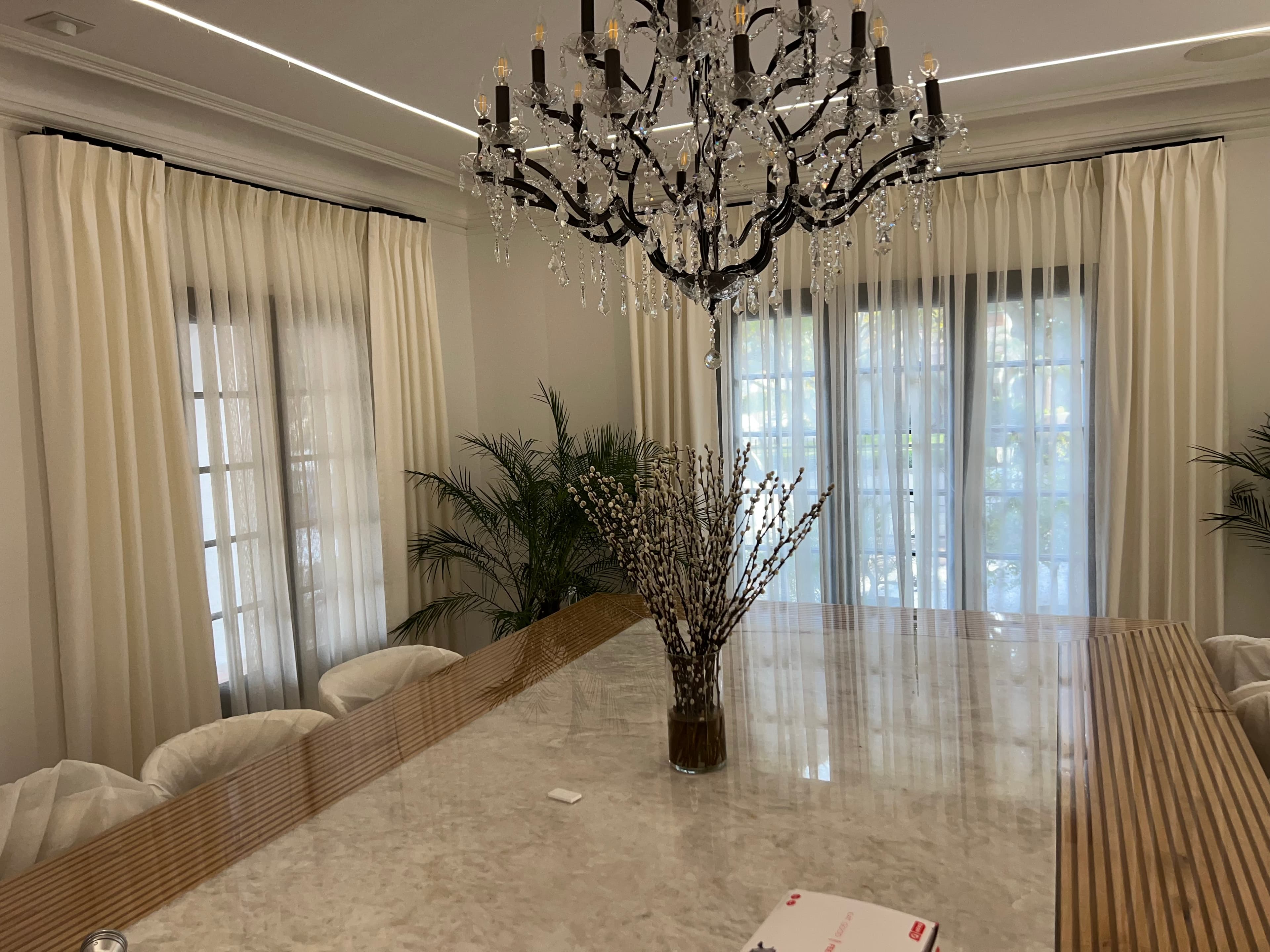
Two, most of the time, and the reason is stack rather than good manners. Drapery that opens has to go somewhere, and a pair divides that somewhere between both sides of the window, so each side stacks half as deep. One wide panel pushed to a single side stacks twice as deep and eats twice as much glass, which is fine when you meant it and annoying when you didn't.
One panel earns its place when the room argues for it: a door that swings into one side, a corner window with nowhere to stack on the short wall, an entry with a single tall window beside the door, or a stationary panel used to soften one edge of a view. Four panels show up on very long runs where you want the option to stack at both ends, and on wall-of-glass treatments that part in the middle. Sliding doors are their own case: a pair, stacked entirely off the operating side, so the door still works. That geometry gets more involved as openings grow, which is the subject of the extra wide page.
The width math, panel by panel
Four inputs, one formula. Start with the rod width, which is the window plus the coverage you want on each side, typically 4 to 10 inches. Multiply by the fullness your header calls for. Divide by the number of panels. Add the return, the few inches of fabric that wrap back to the wall at the outer edge, usually about 3 and a half inches on standard brackets and more when the drapery layers over a shade.
Run it on a real window. A 48 inch frame with 4 inches of coverage per side gives a 56 inch rod. At pinch pleat fullness of 2.25x that's 126 inches of fabric width. Split across a pair and add the return, and each panel finishes around 67 inches wide. Both panels are wider than the window. That's not a mistake in the arithmetic, it's the entire difference between drapery and a bedsheet on a pole, and it's why a stock pair of 50 inch panels looks thin on the same window even though it nominally covers the glass. The measurement tool runs this calculation for your dimensions in a few seconds, and the measuring guide explains every rule behind it.
Fullness by header, because they differ
Headers carry different amounts of fabric, so the multiplier changes with the style you pick. Pinch pleat and tailored pleat both run about 2.25x, the tailored version reading cleaner and the pinch version fuller at the top. Ripple fold sits near 2.1x and spends that fabric on even waves rather than a structured heading. Rod pocket and back tab both land around 2x. Grommet is the lightest at about 1.8x, since the rings themselves set the fold depth. Sheers want 2.5x to 3x regardless of header, because thin fabric needs more of itself to look like anything. The broader family of pleated options lives on the pleated curtains page.
Why panels get seamed
Drapery goods run about 54 inches wide off the roll. Our 67 inch panel from the example above is wider than that, so it's built from two widths of fabric joined in the workroom. This surprises people, and it shouldn't: every properly full panel past about 50 inches finished is a seamed panel, including the good ones in the magazines. The craft is in where the seam goes and how it's handled. We match pattern repeats across every join, press the seams flat, and place them to fall inside a fold rather than on a face, which is why you can stand in a finished room and not find them. Patterned fabric with a large repeat costs more here, since every width has to start at the same point in the design.
Panels that move, panels that don't
Decide this before you decide fullness, because it changes the fabric bill. Traversing panels open and close daily, so they need full width, a header that glides, and stack space planned into the rod length. Stationary panels frame a window and never move; they can run narrower and at reduced fullness, often around 1.5x, and they pair naturally with a shade doing the actual light control underneath. Plenty of rooms want one of each: stationary linen panels flanking a picture window for softness, with a roller shade handling the afternoon. Tell us which job each panel has and we'll size it for that job rather than defaulting everything to full traverse.
Rings, hooks, and lining
Hardware count is the small detail that decides whether a panel hangs or sags. Plan one ring every 4 to 6 inches of finished panel width, an even number, with a ring at each end, so a 60 inch panel takes 12 rings at 5 inch spacing. The end rings do the most work, holding the leading edge straight and the return tight to the wall. Pleated panels swap the rule for a simpler one: a hook at every pleat, plus one at the return and one at the leading edge.
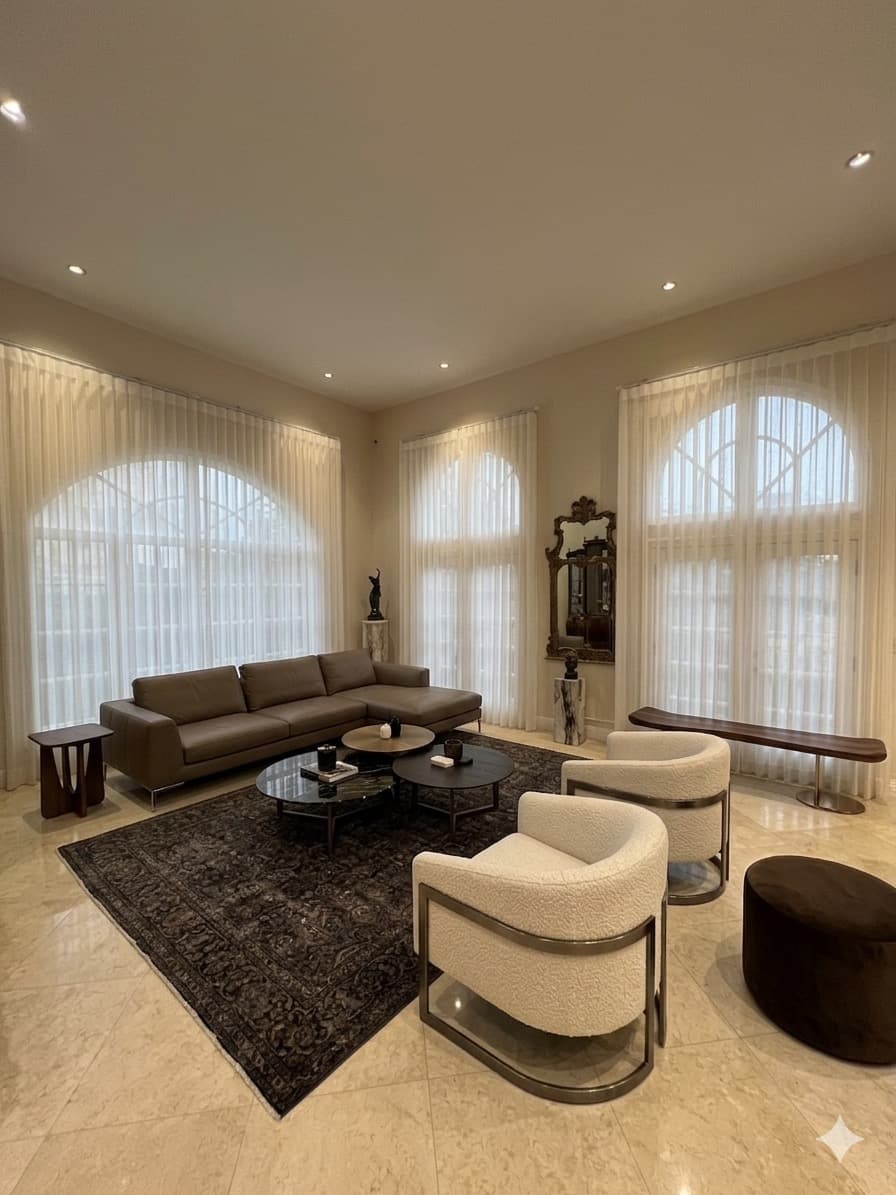
Lining is the other decision that lives at the panel level rather than the window level. Unlined keeps linens luminous and sheers sheer. Standard cotton sateen lining adds body, protects the face fabric from sun, and makes the street side of the house uniform. Blackout lining turns the same panel into a bedroom tool. Interlining, a flannel layer between face and lining, is what makes a panel stand rather than hang, and it's the upgrade we recommend most often on long drops. All of it is spelled out on the custom made curtains page.
A recent panel order
Ordinary work, and a good illustration. A living room with two windows flanking a fireplace, both 46 inches wide, where the owner had bought a stock pair for each and hung them for a month before deciding something was off. Nothing was wrong with the fabric. Each panel was 50 inches wide where the math wanted 63, so the pairs read flat and the pleats never formed. We rebuilt them as four panels at 63 inches each in a similar linen, tailored pleat, float length, and the fireplace wall finally looked deliberate. Same window, same color, twice the fabric, entirely different room.
Ordering, two ways
Anywhere in the US: send your rod dimensions and photos, we confirm the panel count and finished widths before anything is cut, and the panels arrive rolled with the rings or hooks you'll need. In Los Angeles and Ventura counties, the measurement and the installation are free, and the panel count stops being your decision to second-guess. Designers and trade accounts working across multiple rooms should start at the drapery page, which covers the workroom on industry terms.
Frequently asked questions
What is a drapery panel?
A panel is one piece of drapery. Two panels make a pair, which is why a retailer selling you "curtains" for one window is usually selling you two of something. The word matters when you order, because pricing, fabric estimates, and packaging all count panels rather than windows, and a surprising number of returns start with somebody buying one panel for a window that needed two. When we quote, we tell you the panel count, the finished width of each panel, and the finished length, so there's nothing left to interpret.
How many drapery panels do I need?
Two per window in most rooms, and the reason is stack rather than symmetry. A pair splits its open fabric between both sides of the opening, so each side stacks half as deep and covers half as much glass as a single panel would. One panel is right when the room gives you a reason: a door swing on one side, a corner window, an asymmetric wall, or a stationary treatment that frames rather than closes. Very wide openings sometimes take four, so the drapery can stack to both ends or part in the middle, and sliding doors usually take a pair stacked entirely to the fixed side.
How wide should drapery panels be?
Take your rod width, multiply by the fullness your header wants, divide by the number of panels, then add the return that wraps back to the wall. A 48 inch window with 4 inches of coverage on each side gives a 56 inch rod; at pinch pleat fullness that's 126 inches of fabric, so a pair works out around 67 inches per panel once the return is added. Notice that each panel is wider than the whole window. That gap between what people expect and what the math returns is the single most common ordering mistake we see, and it's why stock panels around 50 inches wide look thin on a window they nominally fit.
How much wider should curtains be than the window?
Two to two and a half times wider in total, not a few inches wider. The rule people remember is that the rod should extend 6 to 10 inches past the frame on each side, and that part is true, but it only decides where the fabric stacks. The fullness multiplier decides whether the fabric reads as drapery or as a flat sheet, and it applies to the rod width rather than the window width. Skip it and you get panels that technically cover the glass and visibly announce that somebody economized.
How wide should curtains be?
Wide enough to hold folds when they're closed, which means the combined width of all panels should be 2x to 2.5x your rod width for pleated headers, around 2x for rod pocket and back tab, about 1.8x for grommet, and 2.5x to 3x for sheers, which need more of themselves to read as full. Divide that total by however many panels you're hanging to get the width of each one. Stationary panels that never close are the one honest exception, since decorative-only drapery doesn't need traverse fabric and can sit closer to 1.5x.
How many drapery rings per panel?
Roughly one ring every 4 to 6 inches of finished panel width, always an even number, always with a ring at each end. A 60 inch panel takes 12 rings at 5 inch spacing, and the end rings matter more than the middle ones because they're what keeps the leading edge and the return from sagging away from the rod. Pleated panels change the rule slightly: there you hang one hook per pleat plus one at the return and one at the leading edge, so the pleat spacing does the work the ring spacing would otherwise do. Too few rings is the most common cause of the droop people blame on the fabric.
How do you measure for drapery panels?
Measure the rod, not the window, and measure it after you've decided where the rod goes. Width starts from the rod's bracket-to-bracket span, since finials don't carry fabric. Length runs from where the panel actually hangs down to your chosen hem position, which is the top of the rod for grommet and rod pocket panels and the eye of the ring for anything on rings or hooks, usually about an inch lower. Take the drop at both ends of the window and the middle, because floors settle, and send us photos with your numbers so we can catch anything the tape missed before the fabric is cut.