
A sheer is the one curtain where fullness isn't a preference; it's the product. A flat sheer at stock fullness is a piece of gauze taped over a window. The same fabric at 3x fullness, floor to ceiling, is a glowing wall that softens the room and hides the street by day. The fabric costs the same either way. What differs is the yardage, the sewing, and the fact that somebody measured your window before cutting. That's the case for custom sheers in one paragraph, and it's work our made-to-order workroom does on almost every drapery order, because nearly every good drapery build has a sheer behind it.
What sheers do that nothing else does
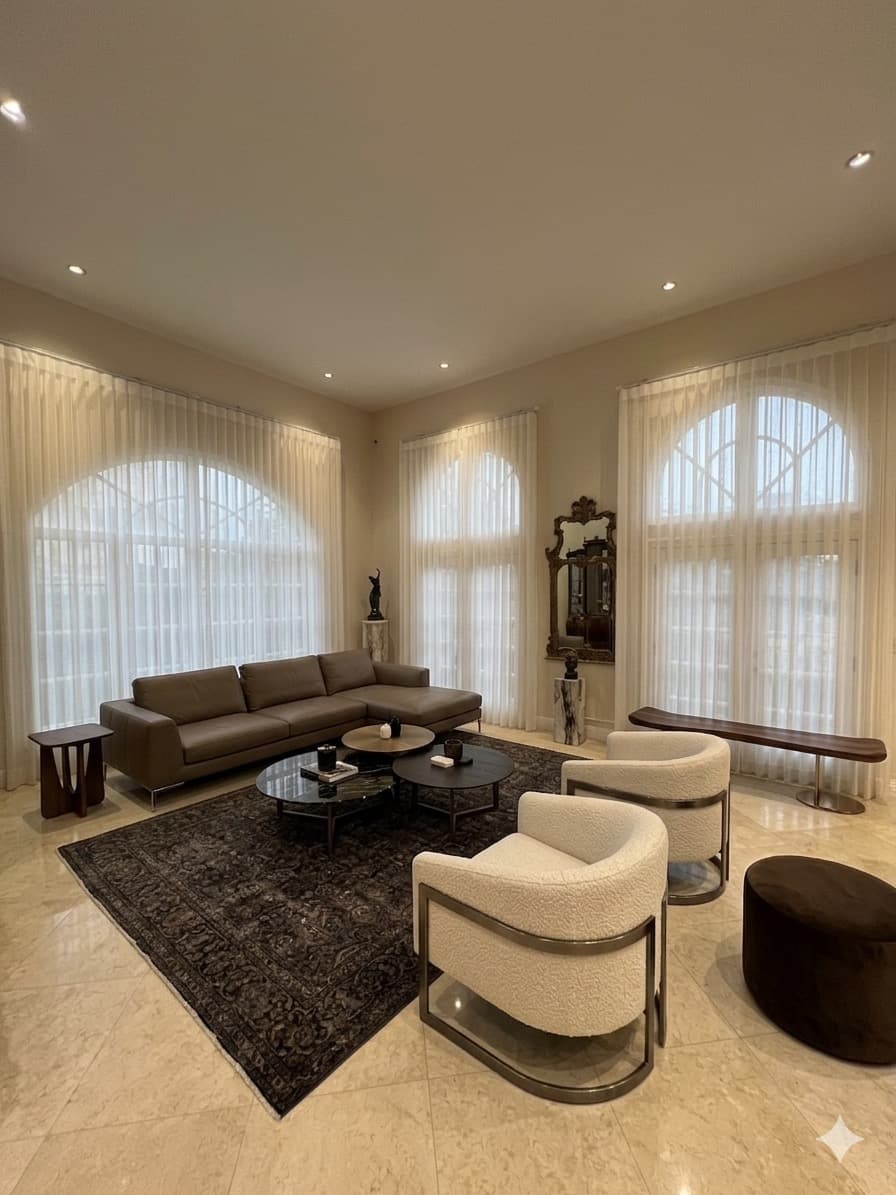
They diffuse. Shades block or filter light from a fixed plane; drapery either covers the glass or doesn't. A sheer takes hard direct sun and spreads it across the whole window as an even glow, so the room brightens without glare and the view from outside blurs into shapes. That's why they work in rooms nothing else quite suits: a living room facing the street where you want light and don't want to be watched, a dining room where a solar shade feels like an office, a bedroom that needs a daytime layer under the blackout. They also make a window read wider and taller than it is, because a full sheer running wall to wall erases the frame.
Choosing the sheer
Three families cover nearly everything we sew. Voile is the classic: a fine, smooth, slightly crisp weave, usually polyester, sometimes cotton, that hangs straight and takes color cleanly. It's the sheer for tailored rooms and for anyone who wants a wash-and-rehang fabric. Linen sheers and the very good linen-look polyesters are the current favorite: a slubby, open texture that reads relaxed and expensive at once, softens light more warmly than voile, and forgives an imperfect wall. Pure linen sheers wrinkle and shift with humidity; the blends don't, and from three feet away you'd struggle to tell. Wide-width sheers are a construction choice more than a look: goods woven 110 to 118 inches wide are railroaded (turned sideways) so a whole window wall can be sewn without a single vertical seam, which matters on extra wide spans where a seam in a sheer shows as a dark line against the light.
Weight decides the hang. Featherweight sheers float and move in any draft, which is charming on a summer window and irritating over an air vent. Midweight sheers hang stiller and read more like a curtain; a small chain weight sewn into the hem keeps either kind straight. Ask for swatches and hold them against the glass in the afternoon, because sheers change character with the light behind them more than any other fabric.
Fullness is the whole game
Sew sheers at 2.5x fullness minimum, and 3x whenever the budget allows. The rule exists because a sheer's beauty is the layered folds, each adding a little more fabric between the room and the glass, and a flat sheer has none of them. At 3x, a 10 foot window wall takes 30 feet of fabric across, which sounds absurd until you see it hang and understand that this is what the rooms in magazines are doing. Fullness also does the privacy work: the same voile that's see-through flat becomes opaque-by-day at triple fullness. Our free measurement tool lets you set the fullness by hand in its advanced panel; for sheers, slide it to 3 and let it do the width math.
Headers for sheers
Ripple fold on a track is the modern answer and the one we sew most: snap tape shapes the sheer into perfectly even S-waves, the panel glides at any width, and a ceiling-mounted track makes the fabric look like it grows out of the ceiling. Pinch pleat and tailored pleat give a sheer a structured spine and suit traditional rooms; the pleats also hide the heading tape, which matters on a fabric you can see through. Rod pocket is the casual classic and works well on stationary sheers that never move. Grommets are the one header we talk people out of for sheers: the metal rings show through the fabric, the columns pull the weave, and a sheer that has to slide over grommets snags. If you want the clean look of a grommet with a sheer, a back tab gives you the same face without the hardware showing.
Layering sheers with drapery or shades
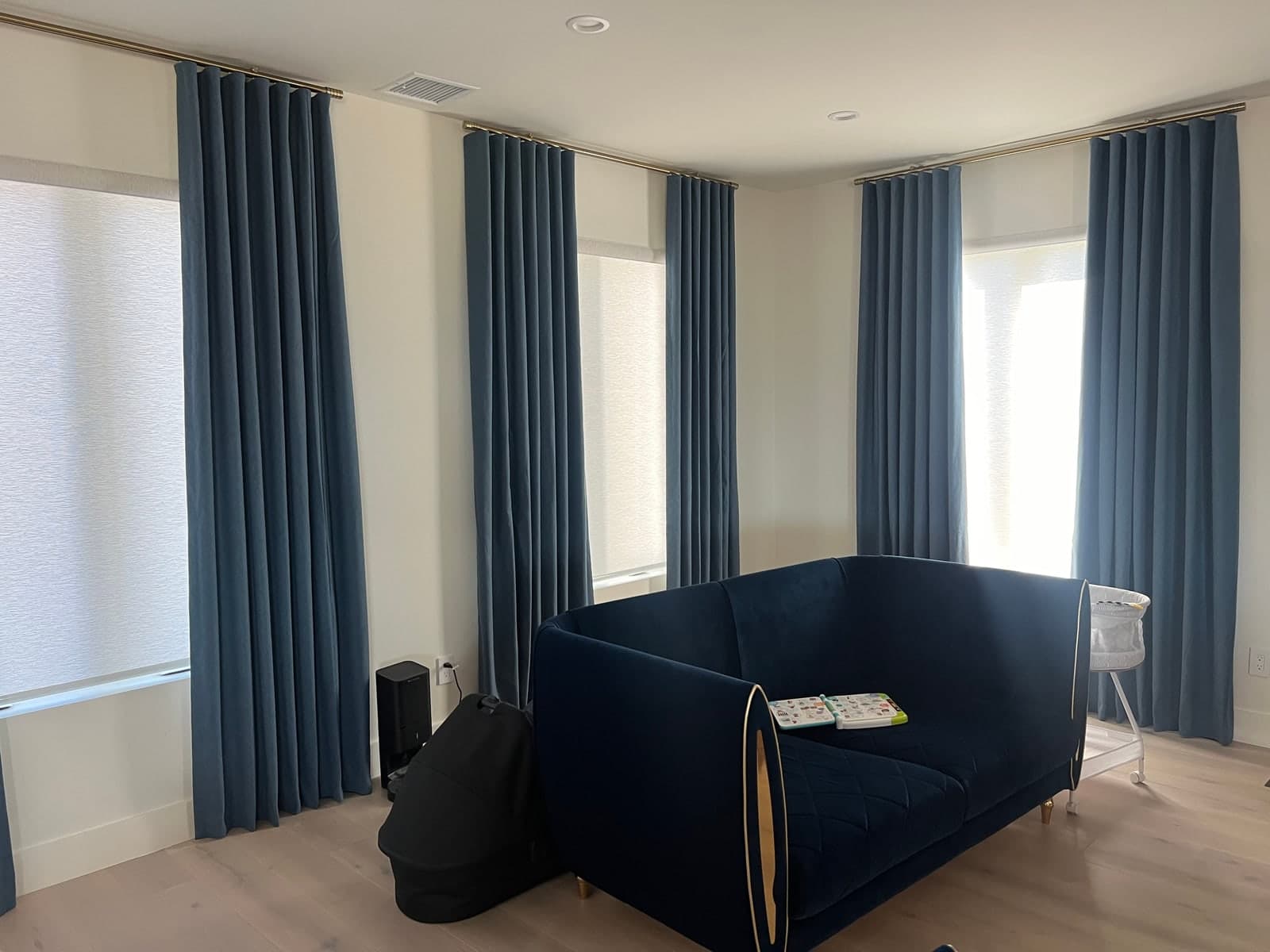
A sheer is the daytime layer; something else takes over at night. With drapery, that means a double rod or a two-channel track, the sheer in back, the lined panel in front, and bracket projection deep enough (5 to 6 inches) to clear both. The drapery's return wraps around the sheer so the side profile stays closed. With shades, the order flips: a roller or zebra shade mounts inside or over the frame and the sheer hangs in front of it, so by day the shade is up and the sheer glows, and at night the shade drops behind. For sliding doors and wide spans where a shade can't work, a vertical sheer shade does both jobs in one product, with rotating sheer vanes that close to opaque. Whichever pairing, sew both layers to the same finished length; a sheer that shows below a drapery hem looks like a mistake because it is one.
Privacy, day and night, honestly
Daytime privacy with a full sheer is excellent: from the sidewalk the window is a bright rectangle and you're a vague shape at most. At night the physics reverse completely and no sheer fixes it. Once the room is lit, a sheer becomes a lampshade and you become the silhouette on it. This isn't a flaw in the product; it's what a semi-transparent fabric is, and the plan should account for it with a second layer closed at dusk. The exception is a window nobody can see into, a hillside bath or a courtyard, where a sheer alone is the right answer and nothing heavier is needed. Tell us where the window faces and we'll tell you honestly whether one layer is enough.
Care
Polyester sheers are the easiest curtains in the house to keep: a cold gentle wash once or twice a year, straight back onto the rod to dry in their folds. Linen and cotton sheers prefer a delicate cycle, no dryer, and rehanging damp so gravity does the pressing. Between washes, a shake-out or a low vacuum handles dust. Sheers fade slower than you'd think because there's so little dye in them to begin with, and the fabric itself is inexpensive enough that when a south-facing sheer finally yellows after a decade, replacing it is a small job. The one enemy is heat: never put a sheer in a hot dryer, because the wrinkles it sets are permanent.
A recent sheer order
A 1960s post-and-beam with a 22 foot living room window wall facing the street: the owners wanted the light and didn't want the neighbors. We sewed a linen-look sheer railroaded from 118 inch goods so the whole run has no vertical seam, ripple fold at 3x fullness on a ceiling-mounted track, floating a half inch above the terrazzo. Twenty-two feet of window became a glowing wall; the street became a rumor. A second track carries lined panels in a pale linen that close at night. That's the standard two-layer build, and it's the one we'd suggest for most street-facing rooms, in LA or anywhere we ship. For the lighter side of the workroom, the unlined linens and cottons that suit casual California rooms are on our custom curtains page.
Ordering, two ways
Anywhere in the US: measure with the tool or the guide, choose the sheer from swatches we send free, and we sew at full fullness and ship rolled in three to four weeks; the process lives on the custom made curtains page. The length calculator settles rod height and hem style if you haven't decided. In Los Angeles and Ventura counties, the measurement and the installation are free, and for a wall-to-wall track over a window wall, that's the part worth handing off. If the room needs true darkness behind the sheer, the front layer is on our blackout curtains page.
Frequently asked questions
What are sheer curtains?
Sheer curtains are lightweight, semi-transparent panels that soften daylight and blur the view without blocking either. The fabric is an open weave, usually a polyester voile, a linen or linen-look sheer, or a cotton batiste, light enough that you can see shapes and brightness through it but not detail. They're the daytime layer in most well-dressed rooms: alone on a window that wants privacy and glow, or behind lined drapery that takes over at night. A custom sheer is the same idea sewn at real fullness and cut to your exact window, which is what separates a wall of soft light from a limp panel.
Do sheer curtains provide privacy?
By day, yes, reliably. When it's brighter outside than inside, a sheer reads as a glowing surface from the street and the person on the sidewalk sees light and vague shapes at best. The weave matters: a dense voile or a linen sheer at 3x fullness hides far more than a thin, flat panel, because the layered folds multiply the fabric between you and the glass. The privacy reverses after dark, which is why we almost always pair sheers with a second layer for bedrooms and street-facing living rooms.
Can you see through sheer curtains at night?
Yes, and there's no sheer that changes this, so plan for it. Once the room is lit and the outside is dark, the physics flip: the sheer glows from the outside and anyone passing can see people and furniture as clear silhouettes. Density and fullness reduce the detail but not the fact. The answer is a second layer, either lined drapery in front of the sheer or a shade behind it, closed at dusk. In rooms with no view issue, like an upstairs bath facing a hillside, sheers alone are fine; anywhere a neighbor or a street can see the window, treat the sheer as the daytime layer.
How do you hang sheer curtains with drapes?
On a double rod or a two-channel track, with the sheer in the back position closest to the glass and the drapery in front. The front layer needs brackets that project far enough to clear the sheer, usually 5 to 6 inches from the wall rather than the standard 3.5, and the drapery's return should be deepened to match so the side profile stays closed. Sew both layers to the same finished length, or hang the sheer a half inch shorter so it never shows below the drapery hem. Ripple fold on a double track is the cleanest version, because both layers glide and stack in the same neat rhythm.
Are sheer curtains still in style?
More than they've been in years. The current version is nothing like the stiff polyester panels of the 1990s: it's a linen or linen-look sheer at 3x fullness, floor length, often on a ceiling-mounted track, running the full width of a wall. Designers use them as a way to soften big glass without losing the light, which is exactly the problem newer LA houses with window walls have. The look that's dated is a single flat sheer stretched across a window at 1.2x fullness; the look that's current is generous, floor to ceiling, and cut to the room.
How do you wash sheer curtains?
Most polyester and poly-blend sheers can go in the washing machine on a cold, gentle cycle, then straight back onto the rod to dry in their folds, which presses them better than any dryer. Linen and cotton sheers want more care: cold water, no agitation beyond a delicate cycle, and rehanging damp to avoid shrinkage and creases. Skip the dryer entirely for any sheer, since heat sets wrinkles and can shrink natural fibers. Between washes, a vacuum with the brush attachment on low, or a shake-out on a breezy day, keeps them fresh; sheers rarely need washing more than once or twice a year.
Can you layer sheer curtains with blackout curtains?
Yes, and it's the layering we build most, because the two fabrics answer opposite halves of the day. The sheer goes in the back position and manages daylight and daytime privacy; the blackout panel goes in front, stacks open beside the window during the day, and closes over the sheer at night. From the sheer's side the details that matter are fullness, which should stay at 2.5x to 3x so the sheer doesn't look thin next to the heavier panel, and length, which should match the blackout layer or run a half inch shorter. Our blackout curtains page covers the front layer's returns and overlaps, which are what make the pairing dark rather than merely dim.