
Pinch pleat is the heading most people picture when they picture drapery. It is also the heading that most clearly separates a custom panel from a ready-made one, because the pleat is structural. Done right, the folds stand up on their own, the columns fall in even verticals from header to hem, and the panel keeps its shape for a decade. Done cheaply, with a strip of pleater tape instead of a sewn buckram header, the top edge waves and the folds collapse into each other within a season. This page covers how we build the real version, what fullness and hardware it wants, and when a different heading would serve your room better. Everything here is sewn to order in our made-to-measure workroom.
How a pinch pleat is actually built
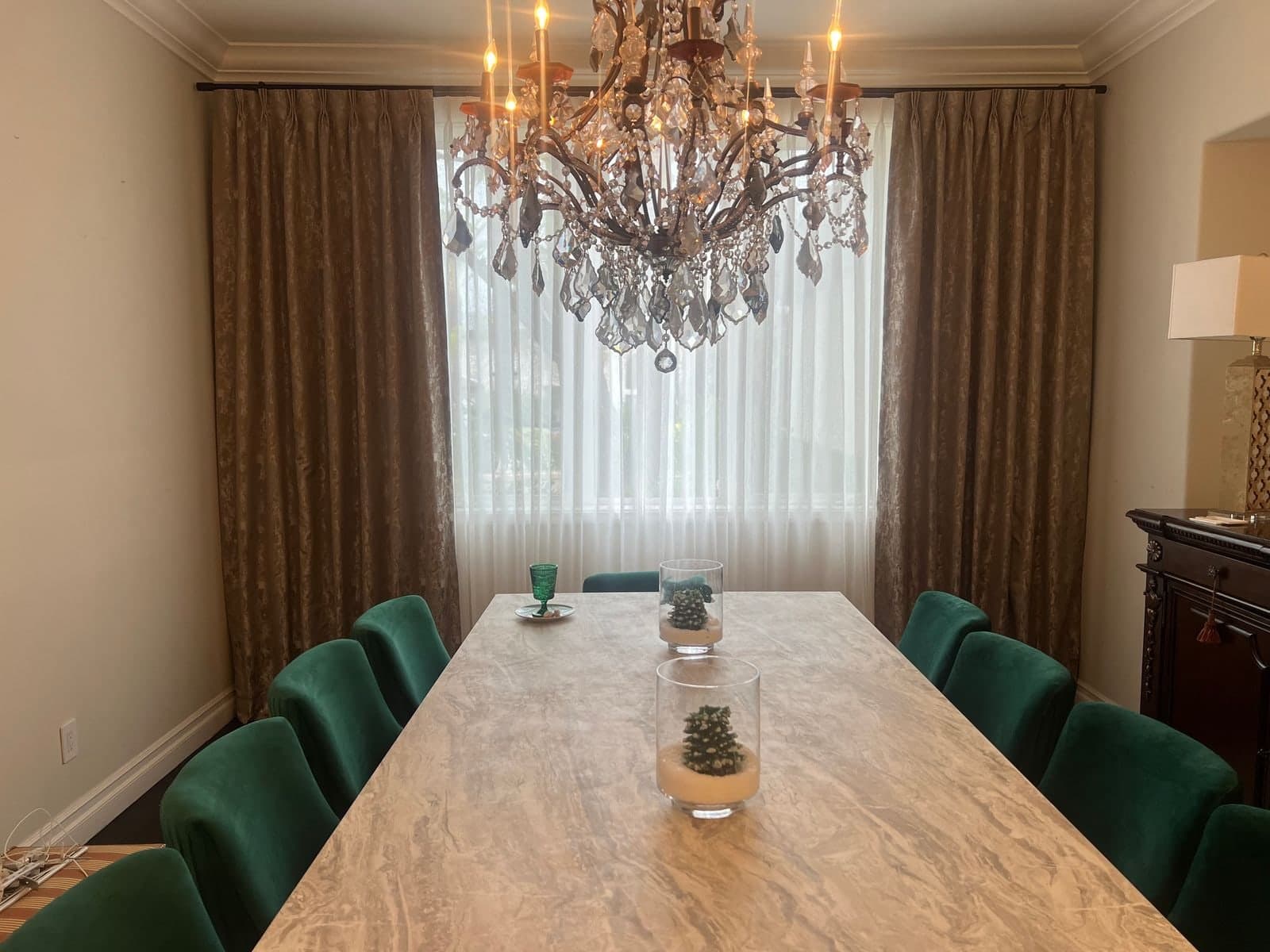
Start at the top edge, because that is where the work is. A band of buckram, a stiff woven interfacing usually four inches deep, gets sewn into the header between the face fabric and the lining. That band is the spine. It holds the top edge dead straight across the width of the panel and gives the pleats something rigid to be formed against. Then the flat fabric is folded into groups of narrow folds, two, three, or five per group, and each group is pinched together and tacked a few inches below the top edge. Above the tack the folds fan open into the shape everyone recognizes. Below it they release into the body of the panel and become the columns that run to the floor.
The finger count is the main variation. Three finger is the standard and the one we recommend to most people: enough structure to read as drapery, not so much that it announces itself. Two finger is slimmer and quieter, and it suits lighter fabrics that cannot carry the bulk of a triple fold. Five finger is the deep traditional heading, at home in a formal dining room with a heavy fabric behind it and distinctly overdressed almost anywhere else. The pinch itself is a small thing that changes the whole character of a panel, which is why we ask about the room before we recommend a number.
Fullness, and why 2.25x is the number
Fullness is the ratio between the fabric in the panel and the rod it covers. Pinch pleat wants 2.25 times the rod width, and that number is not arbitrary. Below about 2x the pleats sit too far apart, the flat spaces between them sag, and the panel reads thin when it is closed. Push much past 2.5x and you are paying for fabric that crowds the rod and stacks into a bigger bundle at the sides than most windows have wall to hide. So a 60 inch rod covered by a pair of panels wants roughly 135 inches of finished fabric width, divided into two panels of about 67 inches each before you add returns.
Fabric comes 54 inches wide as a rule, so a panel that finished width gets seamed from two widths of goods, with the seam falling behind a pleat where it disappears. That seaming is normal, not a compromise, and it is one of the reasons a custom panel costs what it does. If you want the arithmetic run against your own window, our free measurement tool returns the panel width, the finished length, the rod size, and a yardage estimate in a few seconds.
The fabrics that hold a pleat
A pinch pleat needs a fabric with enough body to keep the fold shape. Midweight linens and linen blends are the workroom favorite and the most requested by a wide margin: they take the pleat crisply, hang with a little softness, and read relaxed or formal depending on the room around them. Cotton twills and canvas behave the same way. Velvet makes the most dramatic pinch pleat there is, deep and light-absorbing, though it wants interlining to keep the columns still and it is heavy enough that the hardware has to be chosen for the weight rather than the look.
Two families need care. Very lightweight fabrics, open washed linens and loose weaves, can be pleated beautifully but want a two finger heading and a good lining behind them, because a triple fold in a limp fabric just flops. And sheers are the wrong tool for this heading in most cases: they are better at 2.5x to 3x fullness with a softer top, and a pinch pleat in a sheer tends to look like a formal solution to a casual problem. Lining is the other half of the fabric decision. Standard cotton sateen adds body and protects the face fabric, blackout lining does the bedroom work, and a flannel interlining between the two is what gives a panel that upholstered, old hotel hang.
Hardware: rings, hooks, and traverse rods
Pinch pleat panels hang from drapery pins, and the pin is what makes this heading so flexible. Push a pin into the pocket on the back of each pleat and you can hook the panel onto almost anything. On a decorative rod, each pin hooks into the eyelet at the bottom of a ring, which is the most common residential setup and the one that gives you the visible hardware look. On a traverse rod the pins drop into slides hidden behind the header, so the panel opens and closes with a wand or a cord and the rod itself disappears. On ceiling track the pins go into carriers, which is what we use when the drapery needs to run wall to wall or clear a shade underneath it.
Two details decide whether the finished job looks professional. The first is the return, the fabric that wraps from the outside pleat back to the wall. Put the final ring or carrier outside the bracket so the panel can make that turn, and the light gap at the side closes almost completely. The second is pin depth. Where you set the pin in the pocket controls how far below the rod the fabric hangs, which means a panel that reads a half inch long after installation can be corrected in about a minute without touching the hem.
Measuring for pinch pleat panels
The measurement that trips people up is length, because pleated panels on rings do not hang from the rod. They hang from the eye of the ring, roughly an inch lower. Measure from there to the floor, not from the rod, then subtract a half inch for a float, nothing for a kiss, or add an inch or two for a break. If you are on a traverse rod or ceiling track instead, the fabric starts much closer to the hardware and the same panel would read long, so tell us the hardware before we cut. Rod height is its own decision, and our curtain length calculator settles it against your ceiling with a scale drawing. The full measuring guide explains every rule behind both tools.
A recent order shows how the numbers land. A living room in a 1930s Spanish Revival with a 96 inch rod, three finger pinch in an oatmeal linen with cotton sateen lining, a pair of panels at 2.25x with 3.5 inch returns, hung from rings on an iron rod mounted 14 inches above the frame. Finished length came to 103 inches to float a half inch off an old oak floor that dropped three quarters of an inch across the window. Stock panels would have been wrong twice over, on the length and on the fullness.
When pinch pleat is the wrong answer
It is the wrong answer when the panels have to move constantly by hand, because pinch pleat glides well on track and less well on rings that a person is tugging every morning; grommets are easier there. It is the wrong answer on a very wide span where you want mechanically perfect waves rather than fanned fingers, which is what ripple fold exists for. And it is usually the wrong answer in a small casual room where the heading would be the most formal thing present, in which case a rod pocket or a grommet header is the honest choice. If you like the structure but want it flatter, compare the three pleated headings on our pleated curtains guide, or look at tailored pleat and inverted pleat directly.
Ordering, two ways
Anywhere in the US: send your measurements and a few photos of the window, choose fabric from swatches we mail free, and tell us the hardware you are using. We review your numbers before anything is cut, sew in about three to four weeks, and ship the panels rolled with the pins set. In Los Angeles and Ventura counties the white glove version applies instead, and the measurement and the installation are both free. Pleated drapery is exactly the category where a professional measure earns its keep, since the pin depth, the return, and the ring spacing all get set correctly the first time. Our Los Angeles drapery page covers that service on industry terms, and the pleated drapery collection shows the headings side by side.
Frequently asked questions
What are pinch pleat curtains?
Pinch pleat curtains are panels whose top edge is folded into groups of narrow folds, pinched and tacked together a few inches down from the top so they fan open above the stitch. The industry also calls them French pleats, and the number of folds in each group gives you the variations: two finger for a lighter look, three finger as the standard, five finger for a deep traditional heading. The pleats are sewn over a stiff buckram band hidden inside the header, which is what keeps the top edge straight and the folds standing instead of slumping. They hang from drapery pins pushed into the back of each pleat, so they work on rings, on a traverse rod, or on ceiling track.
How do you hang pinch pleat curtains?
Push a drapery pin into the pocket on the back of each pleat, plus one at each outside edge for the return, then hook those pins onto whatever carries the panel. On a decorative rod that means clipping or hooking each pin into a ring; on a traverse rod it means dropping each pin into a slide; on ceiling track it means a carrier per pin. Set the pin depth before you hang anything, because the pin position is what decides how far below the rod the fabric starts. Push the pin higher in the pocket and the panel rides higher, which is how you fine-tune a hem that reads a half inch long once the panels are up.
How do you hang pinch pleat curtains with rings?
Use one ring per pleat plus one at each end for the return, and hook the pin into the small eyelet at the bottom of the ring rather than around the ring itself. Space the rings so each pleat sits directly under its ring with no fabric pulling sideways, and put the last ring outside the bracket so the panel can wrap back to the wall and close the light gap. The important consequence is for measuring: on rings the fabric hangs from the eye of the ring, roughly an inch below the rod, so the finished panel length has to account for that inch or the hem lands long. We ask which hardware you are using before we cut for exactly this reason.
How do you measure for pinch pleat curtains?
Start with the rod, not the window. Measure the full rod width, decide how many panels you want, and multiply by 2.25 for fullness, then add the return depth so the panel wraps back to the wall at each outside edge. For length, decide the rod height first, then measure from the eye of the ring down to the floor and subtract for your hem style: a half inch for a float, nothing for a kiss, or add an inch or two for a break. Our free measurement tool runs the whole calculation, including yardage, and the length calculator handles rod height if that is the part you are stuck on.
How many pleats should a curtain have?
Enough that the pleats land roughly four to six inches apart across the finished panel, which for most residential windows works out to five to nine pleats per panel. The spacing matters more than the raw count, because evenly spaced pleats are what makes the folds hang in regular columns instead of wandering. A workroom calculates this from your rod width and fullness rather than picking a number: total fabric width minus hems and returns, divided into equal pleats and equal flat spaces between them. When a panel is very wide we add pleats rather than widening the gaps, since wide gaps let the fabric sag between folds.
Are pinch pleat curtains still in style?
Yes, and they have quietly outlasted several trends that were supposed to replace them. What changed is the proportion rather than the pleat: current work runs to lighter fabrics, higher rods, and a two or three finger pleat instead of the deep five finger heading that reads distinctly traditional. A three finger pinch in a washed linen on a slim matte black rod does not look like your grandmother's living room, and it is one of the most requested headings in our workroom. If you want the structure without the classic association, the flatter modern cousins are worth a look.
What is the difference between pinch pleat and tailored pleat?
Both are sewn over a buckram header at the same 2.25x fullness, so they use the same amount of fabric and hang with the same discipline. The difference is at the top: a pinch pleat gathers two, three, or five folds and tacks them together low so they fan open above the stitch, while a tailored pleat is a single fold stitched flat down the face of the heading. Pinch reads traditional and decorative; tailored reads quieter and more architectural. If you like the ordered columns of a pleated panel but find the fanned fingers fussy, tailored pleat is the answer.