
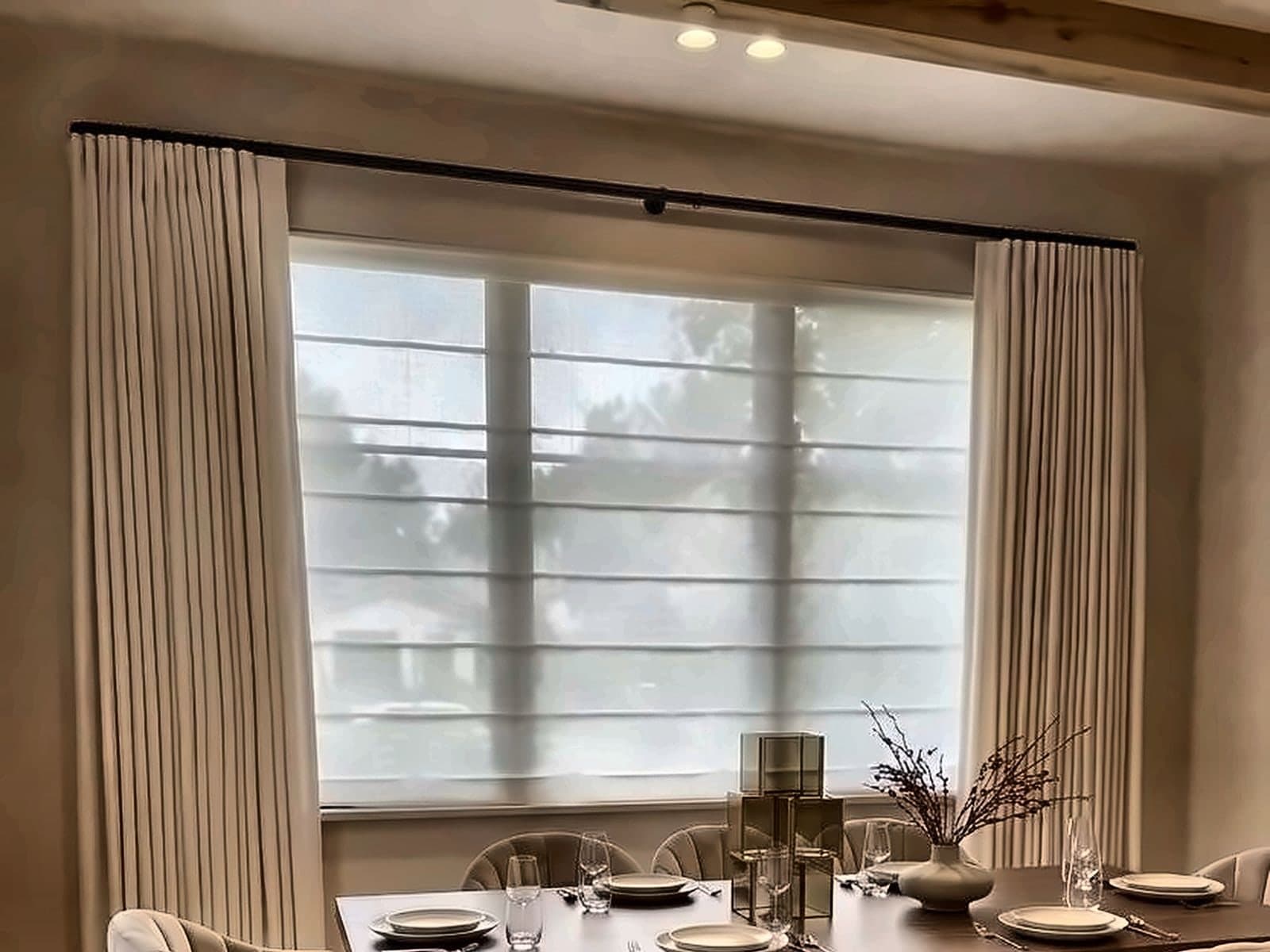
Every other pleated heading puts something on the front of the panel. An inverted pleat puts it on the back. The gathered fabric folds inward behind the face, so what the room sees is an unbroken plane of cloth marked only by a neat vertical seam wherever a pleat sits. It is the flattest of the pleated headings and the one to choose when the fabric itself is the reason you are hanging drapery. Everything here is sewn to order in our made-to-measure workroom, in any width and any drop.
How an inverted pleat is built
The header is standard pleated construction. A band of buckram, stiff woven interfacing about four inches deep, gets sewn into the top between face fabric and lining, and it is what keeps the top edge straight across the full width of the panel. Then each pleat is formed by bringing two points of fabric together at the front and pushing the excess back behind the panel, where it is stitched down out of sight. From the room you see the seam where those two points meet; from behind you see the fold doing the work.
Spacing is calculated, not chosen. We take the finished panel width, subtract side hems and returns, and divide what remains into equal pleats separated by equal flat runs of fabric, targeting four to six inches between folds. Because the flat spaces are the visible part of this heading, that spacing matters more here than on any other pleat: uneven gaps show immediately on a smooth face. Each pleat carries a pocket on the back for a drapery pin, so the panel can hang from rings, a traverse rod, or ceiling track without being rebuilt.
Fullness and what it costs
Inverted pleat runs at 2x to 2.25x the rod width. The lower end of that range is more usable here than on other headings, because a flat face does not depend on packed folds to look right, and stationary panels that never close can sit comfortably at 2x. If the panels will actually traverse and close over the glass, stay at 2.25x so the closed panel reads full rather than stretched.
On a 60 inch rod, a pair at 2.25x wants roughly 135 inches of finished fabric width, plus return depth at each outside edge and 16 to 20 inches per cut for hems and header. Drapery goods run about 54 inches wide, so wider panels get seamed from multiple widths. On this heading we place those seams behind pleats deliberately, since a seam crossing the open face is exactly what an inverted pleat is meant to avoid. Our measurement tool returns panel width, finished length, rod size, and yardage for your own window.
The fabrics this heading was made for
A flat face is a display surface, so the fabric decision carries more weight here than usual. Velvet is the standout: an uninterrupted plane of pile changes color as you cross the room, and interlining keeps that surface perfectly still. Midweight linens and linen blends give the same effect with more texture and less drama. Wools and cotton twills hold the pleat cleanly. Large-scale patterns, embroideries, and anything with a directional weave finally get room to read, which is not true of a heading that folds the design away.
Lightweight and loosely woven fabrics are the ones to think twice about. Without a lining behind it, a flat face in a soft fabric reads slack rather than smooth, and every draft animates it. A cotton sateen lining fixes that in most cases, blackout lining does bedroom duty, and a flannel interlining adds the weight that makes a large panel hang like a wall.
Stationary panels or traversing
Most of the inverted pleat work we do is stationary: a panel at each side of the window, dressed and left alone, with a shade underneath doing the light control. That suits the heading, and it lets you run 2x fullness and spend the savings on better fabric. When panels do need to close, put them on a traverse rod or ceiling track rather than rings, since carriers move a flat-faced panel more evenly than a hand does. Ceiling track is also what we specify for wall-to-wall runs, for drapery layered over a shade, and for anything motorized.
The usual installation details still apply. Set the outermost carrier outside the bracket so the panel wraps back to the wall and closes the side light gap. And on rings, remember the fabric hangs from the eye of the ring rather than the rod, roughly an inch lower, which belongs in the length measurement. Rod height itself is settled by our length calculator, and the measuring guide explains the reasoning behind every rule.
Where it belongs
Modern and Mid-Century rooms take inverted pleat almost by default, as do open plans and any space where one good fabric is the whole design. It works in a traditional room when the drapery is meant to recede. A recent order: a Silver Lake remodel with a pair of tall windows flanking a fireplace, inverted pleat in a slate wool blend, stationary panels at 2x on a slim ceiling track with roller shades handling the afternoon sun. Nothing about the drapery announced itself, which was the brief.
It is the wrong heading when you want visible structure at the top, where tailored pleat or a decorative pinch pleat is better. It is also the wrong heading for casual rooms that would be happier with a rod pocket or grommet panel, and for very wide spans that want the mechanical regularity of ripple fold. The pleated curtains guide lays the three pleated options out side by side.
Ordering, two ways
Anywhere in the US: send measurements and photos, choose fabric from free swatches, and tell us the hardware and whether the panels will be stationary or traversing, since that changes the fullness we recommend. We review your numbers before cutting, sew in about three to four weeks, and ship the panels rolled with the pins set. In Los Angeles and Ventura counties both the measurement and the installation are free. For panel counts and widths on larger projects, see custom drapery panels, and the pleated drapery collection shows the headings together.
Frequently asked questions
What are inverted pleat curtains?
Inverted pleat curtains are pleated panels where the fold is pushed to the back of the panel instead of standing on the front. From the room you see a smooth expanse of fabric interrupted only by a clean vertical seam wherever a pleat sits, and all the gathered fabric is hidden behind. The construction underneath matches any proper pleated panel: buckram sewn into the header to keep the top edge straight, pleat spacing calculated from your rod width, and a drapery pin behind each pleat. The trade sometimes calls it a reverse pleat or a reverse box pleat, and it is the flattest and most contemporary of the pleated headings.
What is the difference between inverted pleat and box pleat?
They are the same fold facing opposite directions. A box pleat puts the flat panel of fabric on the front, standing proud of the surface with the folds tucked behind it, so you see a raised rectangle at each pleat. An inverted pleat reverses that: the fold goes to the back and the front shows only the seam where the two sides of the pleat meet. Box pleats are more often used on valances, bed skirts, and upholstery, where a bit of relief at the top is the point. Inverted pleats are the drapery version, because a flat face is usually what you want running the height of a wall.
Do inverted pleat curtains open and close?
Yes, and they stack compactly when they do, since the pleat folds into itself rather than fanning outward. That said, this is the heading we most often build as stationary panels, one at each side of a window, because a flat face is the reason people choose it and a flat face shows best when it stays put. If the panels do need to move daily, put them on a traverse rod or ceiling track rather than rings, so the fabric slides on carriers instead of being tugged by hand. Motorization works the same way and is common on wide runs.
What fabrics work best for inverted pleat drapery?
Fabrics with body and a face worth showing, because the whole point of this heading is that nothing interrupts the front of the panel. Midweight linens, linen blends, wools, and cotton twills all hold the pleat and hang flat. Velvet is spectacular here, since an unbroken expanse of pile catching light is exactly what the heading is built to display, and it wants interlining to keep the surface still. Large-scale patterns and embroideries also do well, since the flat face gives the design room to read. Very light or loosely woven fabrics need a lining behind them or the flat face reads slack rather than smooth.
Are inverted pleat curtains good for modern rooms?
They are close to purpose-built for them. A modern room usually has big glass, minimal trim, and one or two materials doing the design work, and an inverted pleat gives you drapery that behaves like a plane of fabric rather than a decorative heading. It suits open plans, Mid-Century houses, and any room where the architecture should stay the subject. If you want the same quiet effect with a bit more visible structure at the top, tailored pleat is the next step over.