
Tailored pleat is what most people are actually asking for when they say they want drapery that looks modern but not cheap. It keeps everything that makes a pleated panel hang well, the stiff header, the calculated fold spacing, the even columns falling to the floor, and removes the one element that reads traditional: the fanned fingers at the top. What you get is a line of crisp verticals and almost no ornament. The trade also calls it flat pleat or single pleat, and it comes out of the same made-to-measure workroom as every other heading we sew.
How a tailored pleat is built
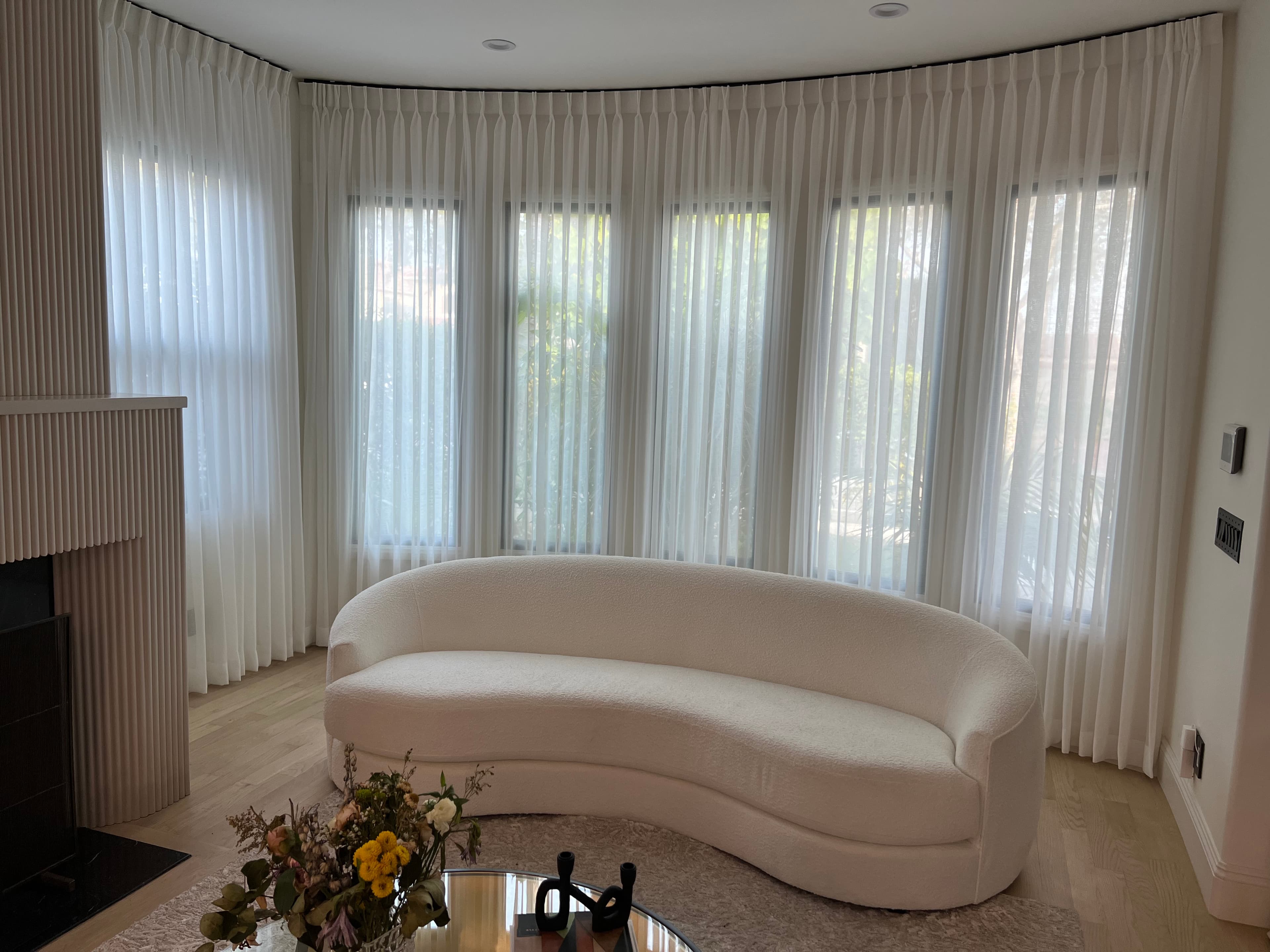
The header starts the same way every pleated panel does. A band of buckram, a stiff woven interfacing roughly four inches deep, is sewn into the top between the face fabric and the lining. That band holds the top edge straight across the full width of the panel, which is what stops a long header from waving. Then, instead of gathering folds into groups, the fabric is taken up into one fold per pleat and that fold is stitched flat down the face of the heading. The crease runs from the top edge down three or four inches and then releases into the body of the panel.
The pleat spacing is calculated rather than chosen. We take the finished panel width, subtract the side hems and the returns, and divide the remainder into equal pleats with equal flat spaces between them, aiming to land the folds four to six inches apart. On a wide panel that means adding pleats rather than widening the gaps, since a wide flat space between folds is where fabric sags. Each pleat gets a pocket on the back for a drapery pin, which is the connection to whatever hardware you are using.
Fullness, and what it costs in fabric
Tailored pleat runs at 2.25x the rod width, the same as pinch pleat. A single fold takes up slightly less fabric than a three finger group at the header, but the fullness across the body of the panel is what actually determines how it hangs, and 2.25x is where a pleated panel looks right closed. Drop below 2x and the flat spaces between folds start to sag; go much past 2.5x and the open panel stacks into a wider bundle than most windows have wall to hide.
So a 60 inch rod covered by a pair wants roughly 135 inches of finished fabric width, plus the return depth at each outside edge and 16 to 20 inches per cut for hems and header. Drapery goods run about 54 inches wide, so panels at that width are seamed from multiple widths with the seams falling behind pleats. Our measurement tool runs the whole calculation, including yardage, against your own window.
The fabrics that suit it
A flat fold needs a fabric that will hold a crease, which puts midweight goods at the center of the range. Linens and linen blends are the most requested and the most forgiving: enough structure to keep the fold, enough texture to stop the flat heading from looking severe. Cotton twill and canvas do the same job with a crisper hand. Wool blends drape beautifully and hold a fold as well as anything. Velvet in a tailored pleat is one of the best-looking things this workroom makes, deep and quiet at once, and it wants interlining to keep the columns still.
The caution is at the light end. Loose weaves and very soft washed linens can be tailored pleated, but the fold needs something behind it or it reads as a wrinkle rather than a crease. A standard cotton sateen lining usually solves it. Blackout lining works here too and is the usual bedroom answer, and a flannel interlining between face and lining gives the panel real weight if you want the columns to stand perfectly still.
Hardware and how it moves
Because the panel hangs from drapery pins, it will go on anything. Rings on a decorative rod give the visible-hardware look and suit panels that mostly stay put. A traverse rod hides behind the header and moves the panels with a wand or cord, which is the right answer for drapery that closes every night. Ceiling track is what we specify for wall-to-wall runs, for drapery layered over a shade, and for motorization. Tailored pleat is a particularly good traverse candidate, since a single fold stacks more compactly at the sides than a fanned group does.
Two details separate a good installation from an average one. Put the outermost ring or carrier outside the bracket so the panel can wrap back to the wall and close the side light gap. And remember that pin depth controls how far below the hardware the fabric hangs, so a hem that reads slightly long after hanging gets fixed at the pin in about a minute. If you are on rings, note that the fabric hangs from the eye of the ring rather than the rod, roughly an inch lower, and that inch belongs in the length measurement. The length calculator settles rod height, and the measuring guide covers the rest.
Where it belongs, and where it does not
Tailored pleat is the default for contemporary rooms, open plans, and anywhere with big glass and minimal trim. It suits offices, it suits bedrooms, and it works in a traditional room when you want the drapery to defer to the furniture rather than compete with it. A recent order: a Mid-Century living room off Mulholland with a fourteen foot glass wall, tailored pleat in a heavy oatmeal linen on a recessed ceiling track, panels stacking off the glass at both ends so the view stays whole during the day.
It is the wrong choice when the room genuinely wants a decorative heading, where a three finger pinch pleat earns its keep. It is the wrong choice when you want the face of the panel completely uninterrupted, which is what inverted pleat is for. And on a very wide span where you want mechanically even waves rather than folds, ripple fold is the better tool. The pleated curtains guide compares all three headings side by side.
Ordering, two ways
Anywhere in the US: send your measurements and photos of the window, pick fabric from swatches we mail free, and tell us what hardware you are hanging from. Your numbers get a human review before anything is cut, sewing takes about three to four weeks, and the panels arrive rolled with the pins already set. In Los Angeles and Ventura counties the measurement and the installation are both free, which on pleated drapery is worth taking: pin depth, return, and ring spacing all get set right the first time. The pleated drapery collection shows the headings together, and our Los Angeles drapery page covers the trade program for designers.
Frequently asked questions
What are tailored pleat curtains?
Tailored pleat curtains are pleated panels whose folds are formed as a single crisp fold each, stitched flat down the face of the heading instead of being pinched into a fan. The trade also calls them flat pleat or single pleat, and you will occasionally see the same construction sold under a European name. Underneath they are built like any proper pleated panel: a band of buckram sewn into the header keeps the top edge straight, the pleat spacing is calculated from your rod width, and a drapery pin behind each pleat carries the panel. The result is a heading that gives you ordered vertical columns with almost nothing decorative happening at the top.
What is the difference between tailored pleat and pinch pleat?
The construction below the header is identical and both run at 2.25x fullness, so they use the same fabric and hang with the same discipline. What changes is the top three inches. A tailored pleat is one fold, stitched flat, standing straight up from the header like a crease. A pinch pleat gathers two, three, or five folds and tacks them together low so they open into a fan above the stitch. Standing in the room, tailored reads as a quiet line of verticals and pinch reads as a decorative heading. Neither hangs better than the other; they suit different rooms.
Do tailored pleat curtains work on a traverse rod?
Yes, and they are one of the better headings for it. Because the pleat is a single flat fold rather than a fanned group, the panel stacks more compactly at the sides when it opens, which matters on a traverse rod where the stack has to sit somewhere. The drapery pins drop into the rod's slides exactly as they would for any pleated panel, and the rod hides behind the header so the hardware disappears. The same is true on ceiling track, which is what we specify for wall-to-wall runs, for drapery layered over a shade, and for anything motorized.
What fabrics suit a tailored pleat?
Fabrics with enough structure to hold a crease. Midweight linens and linen blends are the natural fit and by far the most common choice, since the slight texture keeps a flat heading from looking severe. Cotton twills, canvas, and wool blends all behave well. Velvet makes a tailored pleat look genuinely architectural, though it wants interlining to keep the columns from moving. The fabrics to be careful with are the very soft and very light ones, because a single fold in a limp fabric has nothing holding it upright and the crease reads more like a wrinkle. Lining fixes most of that.
Are tailored pleat curtains formal?
They are tailored without being formal, which is precisely why they have taken over so much contemporary work. The pleat gives you the structure and the even columns that read as real drapery rather than a hung sheet, but the flat top does not carry the traditional associations that a fanned pinch pleat does. In practice that makes it the safest heading for a modern room, an open plan, or anywhere the architecture is doing the talking. Put it in a linen and it reads relaxed; put the same heading in a velvet and it reads serious.