
Most blackout curtains fail at the edges, not the middle. The fabric itself is easy; a decent 3-pass lining stops light cold. What ruins the room at sunrise is the two-inch stripe down each side where the panel stops short of the wall, the glowing seam where a pair doesn't overlap, and the bright line under a hem that floats above the floor. A custom blackout curtain solves those with measurement and construction rather than with a heavier fabric. That's the whole reason to have them made instead of bought, and it's the kind of work our made-to-order workroom does more of than anything else.
What makes a curtain actually blackout
Three things, in order of importance. First, an opaque lining: the industry standard is a 3-pass blackout, a white-black-white sandwich with a foam layer that blocks virtually all direct light and hangs soft enough to fold. Second, coverage: the rod extends well past the frame on both sides, the panels wrap back to the wall in a return, and the pair overlaps by a few inches in the middle so the leading edges never gap. Third, the hem: a kiss or a slight break at the floor, because a half-inch float turns into a glowing line the moment the sun comes around. Get all three right and the room goes properly dark. Get the lining right and the other two wrong, and you've bought expensive fabric for a room that still wakes you up.
Face fabric first, lining second
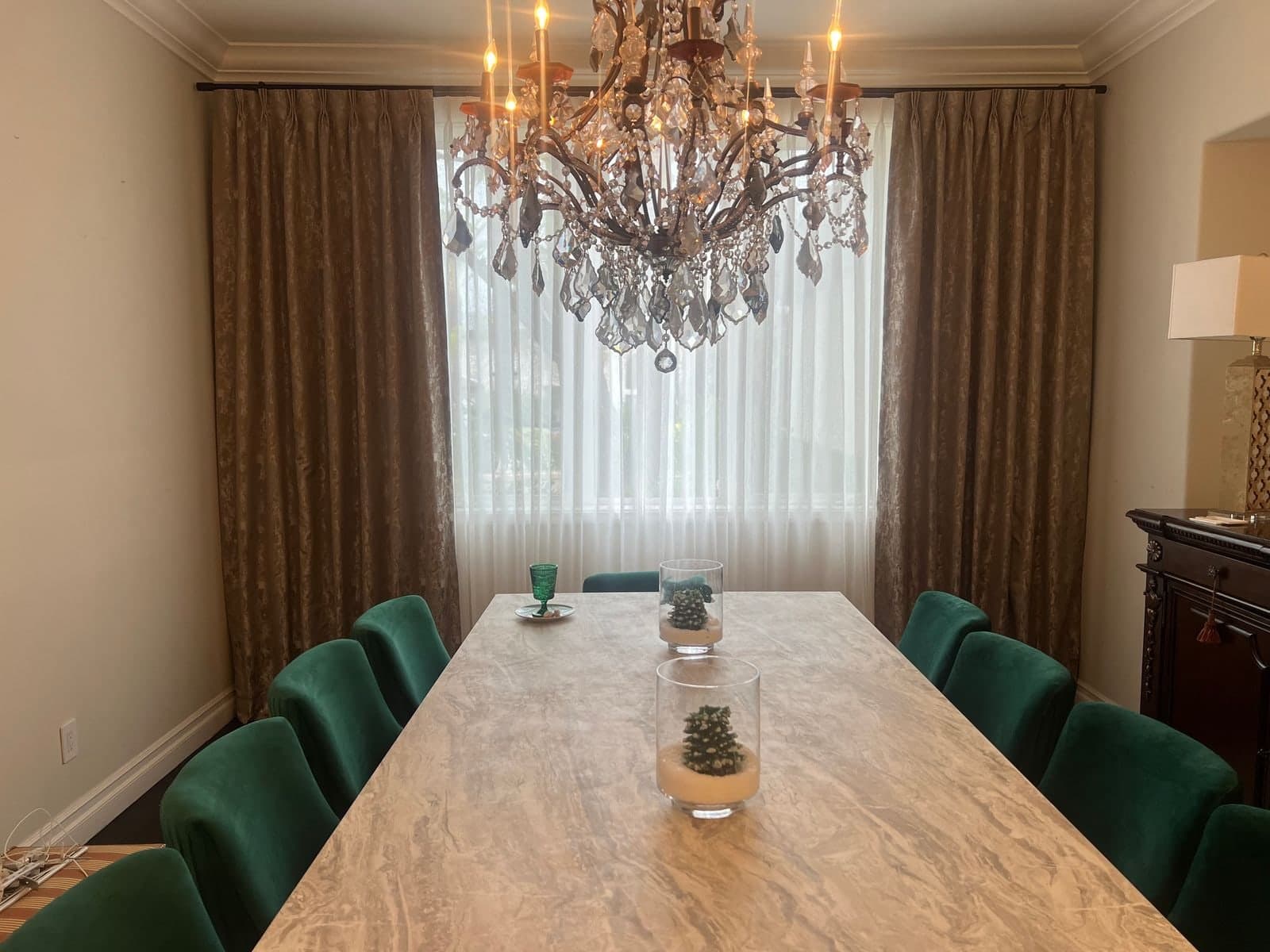
There are two ways to build a blackout curtain and they look completely different in the room. The first, and the one we sew most, is a decorative face fabric with blackout lining behind it: a washed linen, a cotton twill, a wool blend, a velvet, a mill print. From inside the room you see the fabric you chose; the lining is invisible and does its job quietly. The second is a dedicated blackout fabric, a woven that's opaque on its own, usually a polyester with a foam back or a tight triple-weave. It's lighter, cheaper, and looks exactly like what it is, which is fine in a media room and less fine in a bedroom you'd like to feel like a bedroom. Our default recommendation is the first build. It costs more in yardage and sewing, and it's the difference between a room with curtains and a room with blackout curtains.
Weight matters more with blackout than any other build, because the lining alone adds roughly a pound per panel width before you've chosen a face fabric. Light faces like voile and open linen get pulled straight by the lining and lose their character; midweight linens, cottons, and blends carry it well; velvets and wools with a blackout lining behind them become genuinely heavy, and the hardware has to be planned for it. We'll tell you when a fabric you love is going to fight the lining, and suggest the nearest one that won't.
Fullness, lining, and interlining
Sew blackout panels at 2x to 2.5x fullness, the same as any lined drapery, and resist the temptation to go flatter to save fabric. Flat blackout panels look like a hotel's cheapest room, and they hang stiffly because the lining wants to fold in generous pleats rather than shallow ones. The lining itself comes in two useful weights: a standard 3-pass for most bedrooms, and a heavier thermal blackout when the window faces west and heat is half the problem. Interlining, the flannel layer sewn between face and lining, isn't required for darkness at all; we add it when the client wants the fullest, softest hang or real insulation on old single-pane glass. It's the traditional English build and you can see it from the doorway.
Headers that suit blackout drapery
Pleated headers win here, and pinch pleat wins most often. The structure of a pleat holds a heavy lined panel in disciplined columns, the hooks on rings or a track carry the weight without strain, and a pleated panel can be sewn with a proper return that wraps to the wall. Ripple fold on a track is the other strong answer, especially for wide spans: the panels glide, stack tight, and a track can be ceiling mounted with a wraparound end so the light gap at the sides disappears. Grommets and rod pockets are the weak choices for blackout. Grommet panels can't return to the wall, so they leak at the edges, and a rod pocket gathers a heavy lined panel into a bulky, hard to slide heading. If you want a casual look with real darkness, ask about a back tab or a flat panel on a track; both give you the clean face without the leak.
Getting the edges right
This is where measurement pays off, and it's why we review every blackout order before cutting. Run the rod or track 8 to 10 inches past the frame on each side, more if the wall allows, so the panels stack beside the glass and cover the frame with margin. Mount it at least 4 inches above the frame, and higher whenever the ceiling permits, because light bounces down over a low rod. Order the pair with a center overlap of 3 to 4 inches and a return on each outer edge sized to your bracket projection. Take the length to a kiss or a 1 inch break rather than a float. On a 10 foot room that usually means a 108 inch or longer finished drop, which we cut to the half inch of your floor. Our free measurement tool runs the width and fullness math, and the length calculator settles the rod height and hem before you order.
Heat, cold, and noise, honestly
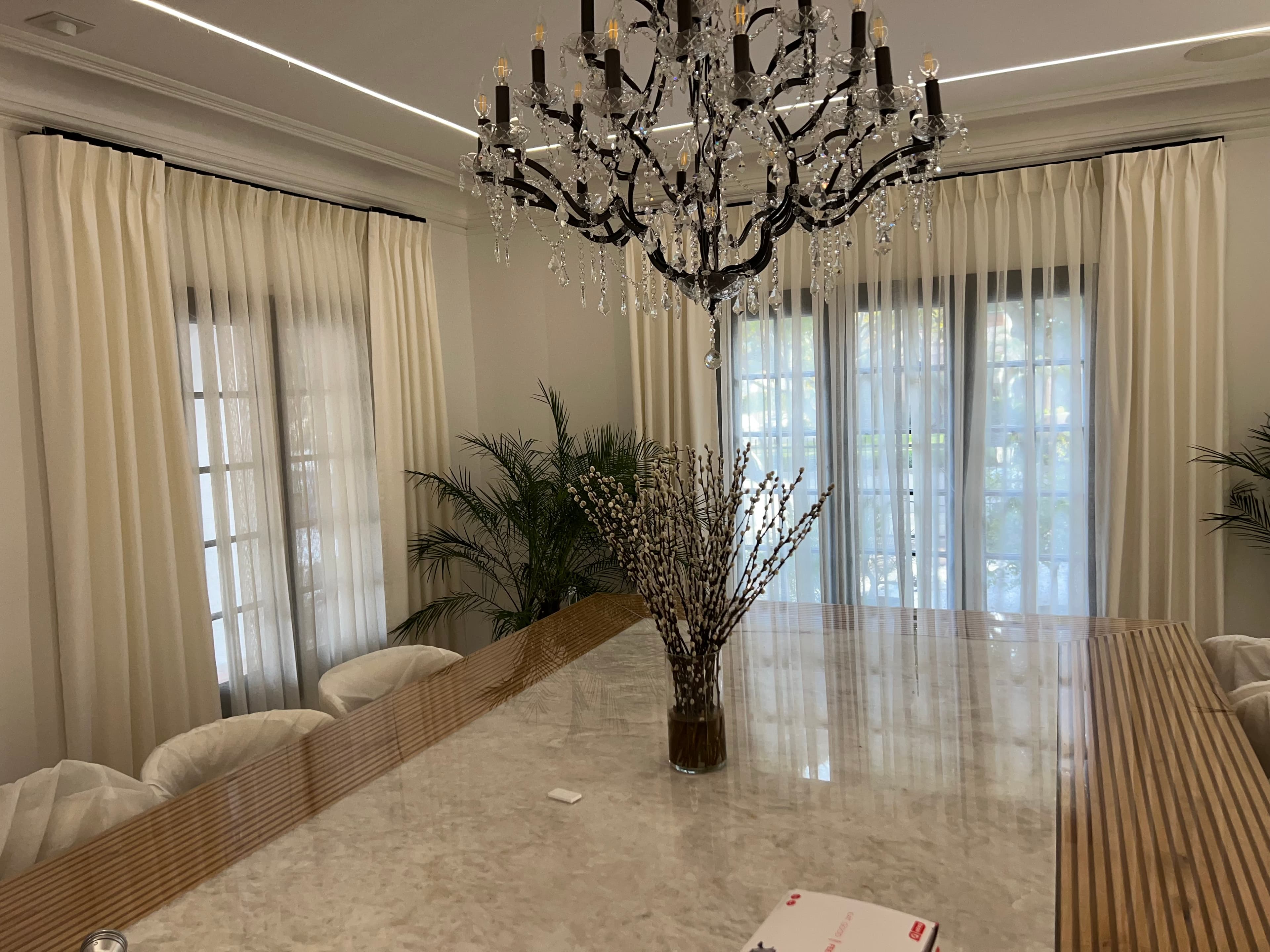
Blackout drapery does three jobs beyond darkness and does them in descending order of strength. Heat is the big one: a closed lined panel stops sunlight at the glass, so a west-facing bedroom stays cooler through the afternoon, and the effect is large enough that clients in Sherman Oaks and Pasadena order lined drapery for the heat first and the darkness second. Cold is the middle job; the trapped air layer helps on single-pane windows, and an interlining roughly doubles the benefit. Noise is the modest one: heavy, full panels soften a room's echo and take the edge off street sound, but no fabric replaces a good window. If you're comparing against shades, our blackout shades page covers the other half of the argument; the two together, a shade inside the frame and drapery over it, is how we build the darkest rooms.
Living with them
Lined drapery lives longest when it moves. Open and close the panels daily and the folds shed dust on their own; vacuum with the upholstery brush a few times a year; spot-clean the face with a barely damp cloth. Keep the whole panel out of the washing machine, because heat and agitation can crack a coated lining and the resulting pinholes don't heal. New panels arrive pressed and want two or three days on the rod to settle into their folds; if a crease persists, a handheld steamer held a few inches off the face fabric fixes it. In hard sun, the lining is also protecting the face fabric from fading, which is why a lined panel outlasts an unlined one by years.
A recent blackout order
A shift nurse in a 1950s ranch house with a bedroom facing east: the brief was sleep at ten in the morning in July. We sewed a pair in a midweight oatmeal linen over a thermal 3-pass lining, pinch pleat at 2.25x fullness, on a track mounted 6 inches above the frame and 10 inches past it on each side, with 4 inch returns and a center overlap. Finished length was a 1 inch break over carpet. From the hallway the room reads as a linen-curtained bedroom. From the bed at ten a.m., it reads as midnight, which was the point. The sheer layer for daytime went on a second channel, built the way our sheer curtains page describes.
Ordering, two ways
Anywhere in the US: measure with the tool or the guide, send numbers and photos, we review before cutting, and lined panels arrive rolled and ready to hang in three to four weeks. The whole process lives on the custom made curtains page. In Los Angeles and Ventura counties, we measure and install free, which for blackout work is worth taking, because the returns, overlaps, and bracket projection are exactly the details an installer gets right on the first pass. If the room is a hotel-dark brief, the two-layer build on our hotel style curtains page is the same system with a sheer in front.
Frequently asked questions
What are blackout curtains?
Blackout curtains are panels built to stop light from passing through the fabric, usually by sewing an opaque lining behind a normal decorative face fabric. The lining is the working part: a 3-pass blackout lining has a layer of black foam sandwiched between two white layers, and it blocks virtually all direct light while staying soft enough to hang in folds. What separates a blackout curtain from a room-darkening one is the lining's opacity plus how the panels are hung, because fabric that blocks light still leaks around the edges if the rod stops at the frame.
Do blackout curtains keep heat out?
Yes, noticeably, and the mechanism is simple: sunlight that never reaches the room can't heat it. A lined panel closed against a west-facing window on a hot afternoon stops the radiant load at the glass, and the foam layer in a 3-pass lining adds a little real insulation on top of that. The effect depends on coverage: panels that wrap to the wall at the sides and overlap in the middle trap far more heat than a flat pair hung inside the frame. In our Valley installs, bedrooms with lined drapery routinely read cooler in August than the same rooms with shades alone.
Do blackout curtains keep cold out?
They help, for the same reason a blanket helps: a closed, lined panel traps a layer of still air between the fabric and the glass, which slows heat loss through single-pane windows. The gain is real but modest with a standard blackout lining, and it improves considerably if you add a flannel interlining, which is the traditional way drapery was made to insulate drafty houses. If cold is the main brief rather than darkness, tell us; we'll often recommend an interlined build over a heavier blackout fabric, because the interlining does more for warmth and the drape hangs better for it.
Do blackout curtains reduce noise?
A little, and it's worth being honest about how little. Heavy lined drapery absorbs some of the high-frequency sound that bounces around a hard room, so a street with tire noise or a neighbor's voices will read softer with the panels closed. It won't stop low rumble, and nothing made of fabric substitutes for good windows. The builds that do the most are the heaviest ones: a dense face fabric, blackout lining, and interlining, sewn at full fullness so there's more mass in the folds. We see the biggest difference in rooms facing traffic, where clients report the space sounds calmer even if a decibel meter would only shrug.
How do you layer sheer and blackout curtains?
Put the sheer closest to the glass and the blackout panel in front of it, on a double rod or a two-channel track. By day the blackout panels stack open at the sides and the sheer diffuses the light; at night the blackout panels close over everything. The one detail people miss is bracket projection: the front rod needs to sit far enough off the wall to clear the sheer, usually 5 to 6 inches instead of the standard 3.5, and the blackout panel's return should be deepened to match so the side profile stays closed. Sew both layers to the same finished length and the pairing looks intentional rather than stacked.
How do you measure for blackout curtains?
Measure the same way you would for any outside-mount curtain, then be more generous with every overlap, because each gap is a light leak you'll see at six in the morning. Run the rod 8 to 10 inches past the frame on each side, mount it at least 4 inches above the frame (higher if the ceiling allows), and take the hem to a kiss or a slight break rather than floating above the floor. Plan a wraparound return so the panel curves back to touch the wall at each end. Our free measurement tool does the width and length arithmetic, and for blackout orders we review every set of numbers before cutting.
Can you wash blackout curtains?
Not in a machine, if the lining is a coated 3-pass type; the foam layer can crack and delaminate in hot water and a dryer, and once it does, the pinholes of light are permanent. Vacuum the panels with the upholstery attachment every few months, spot-clean the face fabric with a barely damp cloth, and send them for professional dry cleaning only when they genuinely need it, which for a bedroom is rarely more than every few years. Lined drapery that lives on the rod and gets opened daily stays cleaner than most people expect, because the folds shed dust when they move.