
LA is a hard city to sleep in with the lights it keeps: long summer evenings, bright mornings, streetlights, and the neighbor's landscape lighting running like a runway. "Blackout" is the most-requested word in our bedroom consultations, and also the most oversold word in this industry, so this page explains what actually produces darkness and what just says it on the label.
Darkness is a system
Three things determine how dark a room gets, and the fabric is only the first. The material must be genuinely opaque (a coated blackout or 3-pass fabric, not a dense weave hoping for the best). The edges must be managed, because light doesn't diffuse politely; it knifes through every gap the hardware leaves. And the mounting must match the goal: an inside-mount blackout roller in a bright exposure gives you a dark room with two glowing pinstripes at dawn, which is performing exactly as built and still disappointing whoever bought it. We design all three layers on purpose, which is most of what separates a blackout system from a blackout SKU.
The products that do it
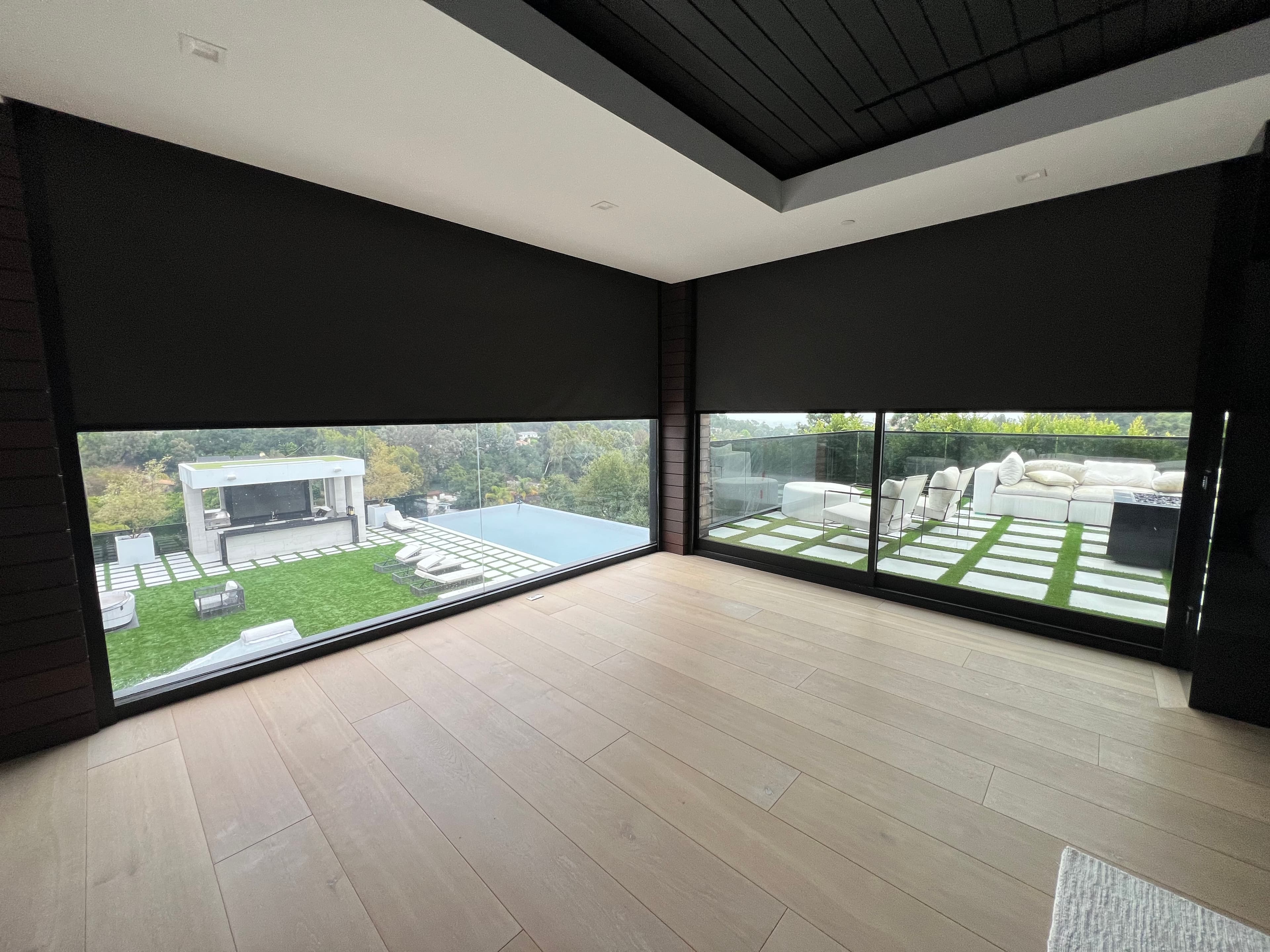
Blackout rollers, ideally outside-mounted with 2 to 3 inches of overlap, are the workhorse; add side channels for media-room grade darkness. Blackout zebras keep the banded modern look and close fully opaque, the right call where the same window works day and night shifts; the mechanics live in the zebra guide. Blackout-lined romans put real darkness behind a sewn, decorative face, our standard nursery and guest-room answer, covered in depth on the roman shades page. And layered systems, a blackout shade under lined drapery, produce both the darkest and best-looking rooms we make, because each layer does the job it's good at.
Rooms we build dark
Bedrooms lead, and the brief varies more than people expect: a teenager's room needs functional darkness, a shift worker's needs aerospace darkness, and the design responds accordingly. Nurseries are their own discipline: cordless or motorized only, darkness deep enough for daytime naps, fabrics that forgive. Media rooms want channeled blackout and zero glow, full stop. And primary suites usually get the layered system, because the room that wants the most darkness is also the room people want to look the best. Whole-home context, including where blackout is a waste of money, is in the complete LA guide.
How the LA service works
A free in-home measurement first, where we check each window's mounting depth, squareness, and exposure, because those three facts pick the blackout strategy. Then fabric and a firm itemized quote, then fabrication in our LA workroom and a free professional installation. If a room needs to hit a date (a baby, a night-shift start), tell us at the measurement and we'll be straight about the timeline.
Frequently asked questions
What are the best blackout shades for bedrooms?
For most bedrooms, an outside-mounted blackout roller is the best darkness per dollar: opaque fabric, frame overlap that kills the edge gaps, and easy motorization. If the room also wants to look soft, a blackout-lined roman delivers real darkness in a sewn, decorative package, and blackout zebras keep the modern banded look while going opaque. The best answer is often layered: a blackout shade for function, drapery over it for the room's sake.
Do blackout shades block 100 percent of light?
The fabric does; the edges are the battle. An opaque blackout fabric passes essentially no light through itself, but an inside-mounted shade leaves slim gaps at each side where the hardware needs clearance, and sunrise finds them. Outside mounting with generous overlap solves most of it, side channels solve nearly all of it, and a lined drape layered over the shade ends the conversation. We design to the darkness level your household actually needs, which differs between a nursery and a night-shift bedroom.
Are blackout shades good for nurseries?
They're close to standard equipment, and LA's bright evenings make them more useful here than most places. Daytime naps happen in genuinely dark rooms, and earlier summer bedtimes stop being negotiations with the sun. Two specifics we build for in nurseries: cordless or motorized operation only, since dangling chains and cribs don't belong in the same room, and washable-adjacent fabrics or wipeable rollers, because nurseries happen to their windows eventually.
How much do blackout shades cost in Los Angeles?
Blackout fabrics carry a modest premium over their light-filtering versions in every category: rollers stay the affordable anchor, zebras a step up, blackout-lined romans price like the sewn products they are, and layered shade-plus-drapery systems cost the most and darken the best. Size, mounting approach, and motorization move the number more than the blackout upgrade itself. The free in-home measurement gets you an exact per-window quote with installation included.
Blackout shades or blackout curtains, which is better?
Different tools, honestly. A blackout shade seals closer to the glass and wins on pure darkness per inch of wall it occupies, especially outside-mounted or channeled. Blackout curtains (lined drapery) look far better doing it, insulate more, and cover awkward spans, but leave more edge light unless generously oversized. Bedrooms that care about both usually run the pair: shade for the darkness, drapery for the room. Media rooms with no aesthetic agenda just want the channeled shade.
Can blackout shades be motorized?
Yes, and bedrooms are where motorized blackout earns its keep fastest: a scheduled sunrise raise is a genuinely better alarm clock, and a goodnight scene that drops every bedroom shade gets used nightly, forever. We fit Somfy and Rollease Acmeda motors on blackout rollers and zebras, battery or hardwired, with app and smart home control. Details and honest advice about when motorization isn't worth it live on our motorized shades page.