
At 144 inches, drapery is structural. Twelve feet of fabric has real mass, it responds to every draft in a tall room, and it hangs in front of the windows people notice first: the double-height entry, the great room, the stair wall, the glass in a loft conversion. Nothing about sewing it is exotic, but nothing about it forgives shortcuts either. This is the length where the hem construction, the lining choice, and the bracket anchoring all become visible decisions.
Which rooms actually measure 144
Fewer than you'd guess, and this is worth getting right before you order. A 12 foot ceiling is exactly 144 inches of wall, so once the rod sits a few inches below it the honest rod-to-floor drop is more like 138 to 142. Full 144 inch panels belong in a 12 foot room when you're running a track flat against the ceiling, or when you want a deliberate puddle pooling on the floor. Past about 12 and a half feet, 144 becomes the conventional-mount answer.
The rest of the work at this length comes from rooms that don't have a single ceiling height at all: double-height entries and great rooms measured down to the first floor, stair walls where the drop runs to a landing, and converted industrial spaces where the window openings were never designed around residential proportions. In those rooms the number is whatever the tape says, and it's frequently not 144. We sew to the measurement either way; the adjacent answers live at 120 inches below and extra long for everything past this.
Rod to floor is the only number that counts
Ceiling height is a starting point and a frequent liar. What decides the panel is the distance from where the fabric actually hangs down to where you want the hem to land, and both ends of that measurement need a decision first. The hang point is the top of the rod for grommet and rod pocket panels, and the eye of the ring for anything on rings or hooks, typically about an inch lower. The floor end is a style choice: a half inch float, a kiss, a small break, or a puddle.
Take the drop at both ends of the opening and once in the middle, because tall rooms sit in buildings that settle and a half inch of disagreement across twelve feet is common. A laser measure is worth the fifteen dollars here; a tape held overhead at this height is a two-person job that still guesses. The length calculator works out the rod height and panel length for the look you want, and the measurement tool handles the width, fullness, and yardage side.
Seams, repeats, and what they cost
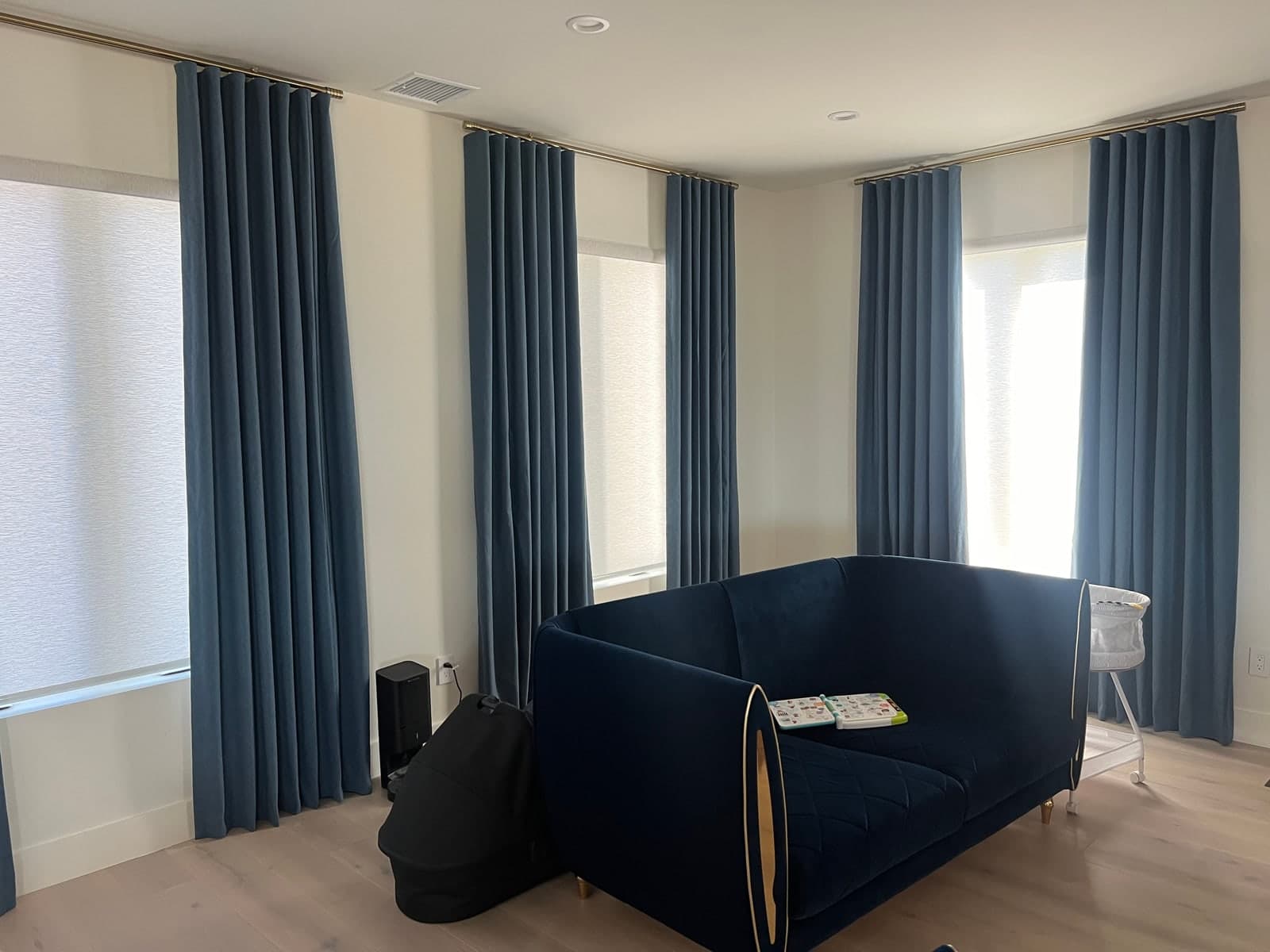
Fabric comes off the roll about 54 inches wide, so a full panel at this height is two or three widths joined vertically. There's no seam across the drop, since the length is cut from one continuous run, but the vertical joins are where a workroom shows its hand. We match the pattern repeat across every width, press the seams flat, and place them to fall inside a fold rather than on a face.
Patterns cost more here than anywhere else in the catalog. Every width has to begin at the same point in the design, so a large repeat can add a yard or more per width before a stitch is sewn, and at 144 inches you're already carrying four and a third yards per width. This is the one place we routinely suggest a textured solid instead: at this scale the fabric's weight and weave read as the pattern, and the budget goes into lining and interlining, where it does more.
Weight, lining, and standing still
Twelve feet of unlined fabric moves. It responds to the air conditioning, to a door opening across the room, to the temperature swing between afternoon and evening, and the movement reads as cheapness even when the fabric isn't cheap. Lining fixes most of it and interlining fixes the rest. That flannel layer sandwiched between face and lining is the difference between panels that hang and panels that stand, and at this drop we recommend it in most formal rooms rather than offering it as an upgrade.
Hems get the same treatment: true double folds with corner weights as standard, and covered lead weighting sewn into the hem where the fabric wants more help. Fabric choice compounds all of this. Velvet delivers the most presence at height and wants interlining to keep its columns still. Linen is the workroom favorite and hangs beautifully once it's lined. Very lightweight unlined cottons are the one family we talk people out of at twelve feet.
Hardware, tracks, and reach
Hardware inherits every pound of that fabric. Brackets anchor into studs or installed blocking, never into drywall alone. Spans past about six feet take a center support, and long runs take several. Ceiling tracks need the blocking verified before anyone drills, which on a finished double-height wall sometimes means finding it from the floor above.
Then there's the question nobody asks until installation day: who opens these. A panel whose header sits twelve feet up is not something anyone reaches, so either the treatment is stationary by design or it's motorized. Heavy panels also traverse more smoothly on a motor than on a hand pull or a wand, so the case gets easier as the drop grows. The motorization page covers the systems we fit and how they're powered, and the floor to ceiling guide takes on the proportion question in double-height rooms, where dressing the entire wall isn't always the right call.
A recent 144 inch order
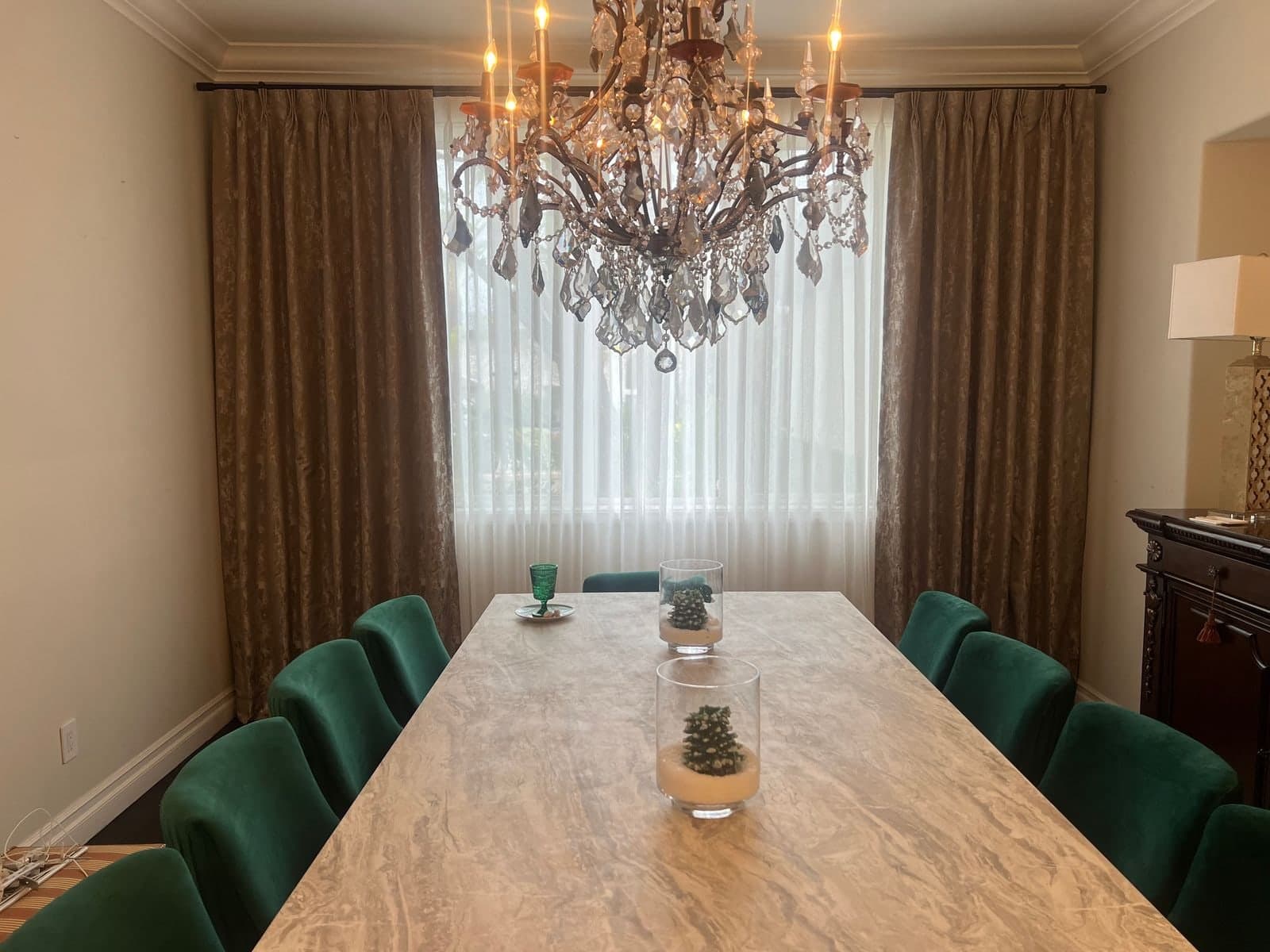
A converted loft downtown, brick wall, steel-framed windows running past twelve feet to a concrete floor. The drop measured 143 and a quarter at one end and 144 at the other, which is what old industrial floors do. We sewed a pair per opening in an interlined wool blend, ripple fold on ceiling track, motorized because the headers sit well out of reach, hemmed to a half inch float at the shorter end so nothing drags at the longer one. The panels arrived rolled, went up in an afternoon on proper ladders, and the room finally had a soft surface in it. No stock length exists for that opening, and no stock fabric would have carried the weight.
Ordering, two ways
Anywhere in the US: take the drop at three points, send the numbers with photos of the full wall, and we review everything against the proportions before cutting. Panels ship rolled with hardware guidance sized to the load. The whole process is on the custom made curtains page. In Los Angeles and Ventura counties, the measurement and the installation are free, which at twelve feet is the version most people want anyway.
Frequently asked questions
What length curtains for 12 foot ceilings?
Usually a bit less than 144, which surprises people who assume 12 feet means a 144 inch panel. A 12 foot ceiling is 144 inches of wall, and once the rod sits a few inches below it the rod-to-floor drop lands closer to 138 to 142, so that's the number a floating or kissing hem wants. Full 144 inch panels are right in a 12 foot room when you're mounting a track flat to the ceiling, or when you want a deliberate puddle, and they're right at conventional mounting once the room passes about 12 and a half feet. Measure rod to floor and let that decide, because the ceiling number alone never does.
Do they make 144 inch curtains?
We do, and a handful of retailers list something at this length in one or two basic fabrics. What almost nobody does is sell it in the fabric you actually want, which is the real constraint at this drop. Because every panel here starts from flat yardage, the length stops limiting the fabric choice: you pick the linen, velvet, or sheer first and the 144 inches follows. Panels at this size ship rolled rather than folded, since a crease pressed into twelve feet of fabric is a long crease.
Do 144 inch curtains need to be seamed?
Across the width, almost always, and along the length, never. Drapery goods run about 54 inches wide off the roll, so any panel finishing wider than that is built from multiple widths joined vertically, and at proper fullness a 144 inch panel is usually two or three widths. The length itself is cut from a single continuous run of fabric, so there's no horizontal seam anywhere on the drop. Patterned fabric adds cost here because every width has to start at the same point in the repeat, which on a large repeat can mean an extra yard or more per width.
How much fabric do 144 inch curtains need?
More than most people budget for. A 144 inch finished drop cuts from about 156 inches of goods once hems and header allowance are added, which is roughly four and a third yards per width before anything else. A properly full pair usually seams two widths per panel, so you're near 20 yards for one window with cutting overage included, and a large pattern repeat pushes it higher. That yardage is the honest majority of what a treatment this size costs, and it's also why the drape reads the way it does.
How do you hang 144 inch curtains?
From structure, with help, and usually from the ceiling. A pair of lined panels at this drop is genuinely heavy, so brackets have to land in studs or blocking rather than drywall anchors, spans past about six feet need a center support, and ceiling tracks want the blocking confirmed before anyone drills. The install itself is two people and real ladders, because twelve feet of fabric is awkward to lift straight and easy to crease. Every national order ships with hardware guidance matched to what you bought, and in LA and Ventura counties our own crew does the hanging.
How much do 144 inch curtains cost?
The drivers are the same as any custom order, just scaled up: fabric grade first, then yardage, then construction. At this drop the construction side stops being optional, since weighted hems, lining, and often interlining are what keep twelve feet of fabric hanging straight rather than moving with the room. Hardware is a real line item too, because the rod or track has to carry the weight across the span. We quote against your exact windows before you commit, so the number reflects your room instead of a length surcharge table.