
Roller shades are where most LA window projects should start and where plenty should end. They're the least expensive thing we make custom, the easiest to motorize, and the most forgiving to live with. They're also the category where cheap and custom look most similar in a photo and least similar after a year on a west-facing window, which is worth understanding before you buy either one.
The four fabric families
Solar fabrics are open weaves rated by openness factor: a 3 to 5 percent weave for serious glare on big exposures, 10 percent where the view matters more than the blaze. They're the LA signature shade, built for exactly the afternoon this city serves daily. Light filtering fabrics close the view and keep the glow, the soft default for living spaces and street-facing rooms. Blackout fabrics go opaque for bedrooms and media rooms, with the mounting caveats covered below. And designer fabrics (textures, weaves, patterns) dress up the category for rooms where a plain roller reads too commercial. All four live on the roller shades page with photos.
Why exact sizing is the whole product
A roller shade is a rectangle of fabric on a tube; the entire difference between custom and stock is how honestly that rectangle matches your window. Stock sizes leave fat margins that leak light and look rented. Custom fabrication cuts the tube and fabric to your opening measured at three points, so an inside mount clears the frame by the minimum the hardware needs and nothing more. Add the parts big-box skips (fascia or cassette valances that hide the roll, spring assists sized to the fabric weight) and the same simple product starts behaving like millwork. Our measuring guide covers the inside-mount rules if you're curious what we're doing with the tape.
Rollers in LA rooms
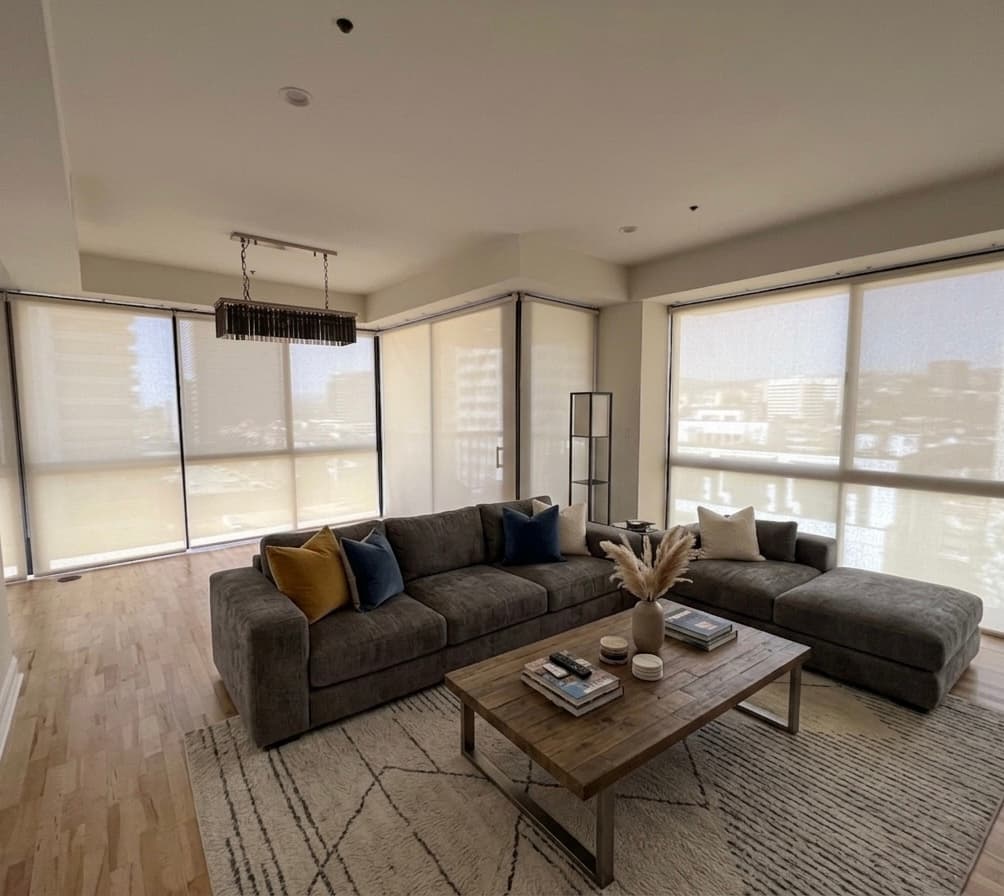
The patterns from our install book: solar rollers on the west glass in the hills and at the beach, where the view is the point and the glare is the tax. Blackout rollers in bedrooms everywhere, often behind drapery that does the daytime decorating. Light-filtering rollers in offices and kids' rooms, cheap enough to do every window and clean enough to disappear. And motorized banks across the glass walls of newer builds, five shades moving as one on a schedule; the full motorization picture is on the motorized shades page. Where rollers lose: rooms that want softness and character, which is roman territory, and windows where adjustable view-versus-privacy matters all day, where zebras earn their premium.
Hardware, the part you notice later
The tube and fabric get chosen in an afternoon; the hardware decisions follow you for a decade. Open roll shows the fabric wound on its tube, fine in casual rooms. A fascia (a clean aluminum face) or a cassette (a fully enclosed headbox) hides the roll for a finished, architectural look that's worth its modest cost in formal spaces. Lift choices run chain, cordless spring, or motor, and homes with small children should treat cordless as the floor, not the upgrade. Reverse roll versus standard roll matters when the window has a crank handle or the fabric has a face; it's a ten-second decision at the measurement that's annoying to fix after.
How the LA service works
The same arc as everything from this workroom: a free in-home measurement, fabric swatches in your actual light, a firm itemized quote, then fabrication and a free professional installation anywhere in LA and Ventura counties. Rollers are often the fastest category start to finish. The broader decision framework across every treatment type is in the complete LA guide.
Frequently asked questions
What are the different types of roller shades?
Four fabric families cover the category. Solar shades use an open weave measured by openness factor (a 3 percent weave blocks more glare and view than a 10 percent) and exist to kill glare and UV while keeping the outlook. Light-filtering fabrics glow rather than see through, softening a room's daylight. Blackout fabrics are opaque for sleep and screens. And designer fabrics bring texture and pattern to what's usually a plain category. Same mechanism throughout; the fabric is the decision.
How much do roller shades cost in Los Angeles?
Rollers are the most affordable custom category we make, which is part of why they're everywhere. The number moves with size, fabric family (solar and blackout typically price above basic light filtering), hardware choice like cassettes or fascia, and motorization. Custom costs more than a big-box stock roller and buys exact sizing without light-leak margins, better fabric, and included professional installation. The free measurement gets you an itemized per-window quote.
What is the difference between solar shades and regular roller shades?
A solar shade is a roller shade in a specific fabric: an open, screen-like weave designed to cut glare and UV while preserving the view through it, rated by openness percentage. "Regular" light-filtering or blackout rollers use closed fabrics that trade the view for glow or darkness. West-facing LA rooms with a view worth keeping are the solar shade's home turf; bedrooms are where the closed fabrics belong.
Do roller shades work for bedrooms?
Blackout rollers are our single most-installed bedroom product, so yes, with one honest caveat: an inside-mounted roller always leaves a slim light gap at each edge, which light sleepers notice at sunrise. The fixes, in ascending order of darkness: outside-mount the shade so it overlaps the frame, add side channels, or layer drapery over it. We'll match the solution to how seriously your household takes its darkness.
Can roller shades be motorized?
Rollers are the easiest and cheapest product in the category to motorize, because the motor slides inside the tube they already have. We fit Somfy and Rollease Acmeda motors, battery or hardwired, with remote, app, and smart home control, and banks of rollers grouping on one command is where motorization shines. If you're choosing between motorizing one large roller or two small ones, bring it to the consultation; the math sometimes surprises people.
Inside mount or outside mount for roller shades?
Inside mount when the opening is square, has about 2 inches of flat depth, and the trim deserves to stay visible: it's the cleaner look. Outside mount when the opening is out of square (common in older LA homes), when depth is missing, or when light control matters, since overlapping the frame kills the edge gaps. We check all three conditions at the measurement, and in pre-war housing we recommend outside mount more often than people expect.