
Roman shades are what happens when drapery learns to behave like a shade. They're our most-requested treatment in LA's older housing stock, where arched Spanish windows and Craftsman trim want fabric softness without floor-length drama, and they're quietly excellent in modern rooms too. This page covers what they are, how they work, the six styles we sew, and what they cost here.
What a roman shade is
A roman shade is a flat panel of drapery fabric engineered to draw upward into horizontal folds. Lowered, it covers the glass like a soft wall; raised, it stacks at the top of the window in neat layers. Unlike roller or zebra shades, which are made from specialized shade fabrics on a tube, a roman starts as ordinary drapery yardage: linen, cotton, wool, a Schumacher print, anything that can be sewn can usually become a roman. That's the category's superpower: it puts real fabric, and real pattern, on windows that don't have room for curtains.
How they work
The mechanism hides on the back. Rows of small rings run down the shade's reverse, lift cords or tapes thread through them to a headrail, and raising the shade gathers the fabric into its folds. The fold style is sewn in, not adjusted later, which is why the style decision comes first. Lift options are cordless (our default, and the only sane choice with small children), continuous loop chain for very large shades, and motorized for the hard-to-reach and the wonderful-to-live-with.
The six styles we sew
Tulip, our most-requested roman, gathers into a soft tulip-shaped scallop at the hem; romantic without going full cottage. Relaxed curves gently at the bottom, the easygoing classic for Spanish and traditional rooms. Pleated stacks crisp, evenly spaced folds for a tailored look. Aventura builds structured panels with clean seams, the most architectural of the six. Cascade overlaps its folds like a waterfall even when lowered, all texture. And classic flat-fold is the minimalist: a smooth face that shows off pattern uninterrupted, the right answer for printed fabrics and modern rooms. Photos of each live on the roman shades page, and swatches plus style photos come to every consultation.
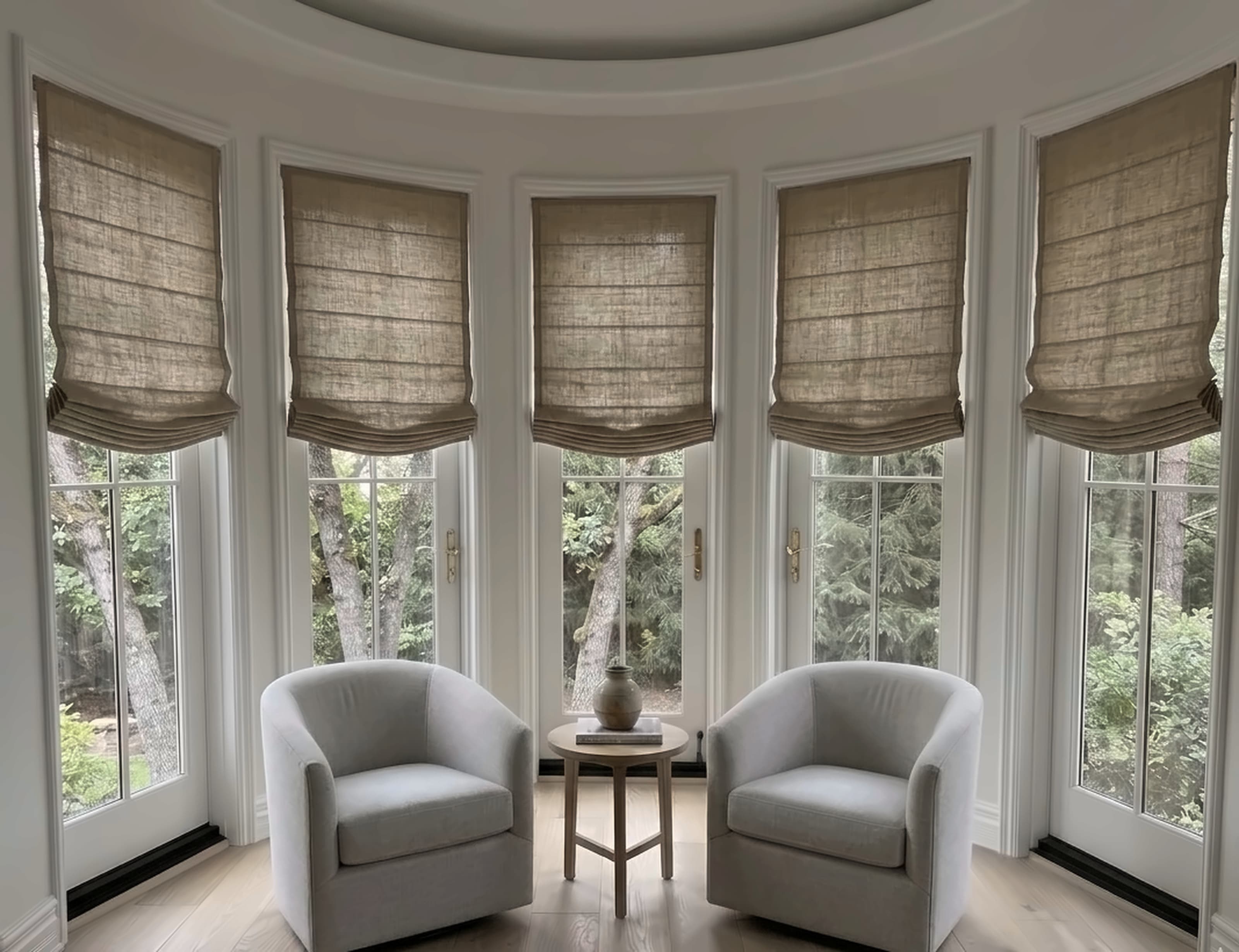
Romans vs rollers vs zebras
The compact version of a comparison we make weekly. Rollers win on price, minimalism, and disappearing when raised. Zebras win on adjustable light without lifting. Romans win on warmth, fabric freedom, and looking sewn rather than manufactured; they're the only shade that reads as decoration even when it's working. They stack deeper than either alternative when raised, eating a few inches of glass, and they carry more fabric, which shows in the price. Rooms that want softness choose romans anyway, and they're right to.
Romans in LA's architecture
Part of why romans thrive here is that so much of LA was built before minimalism. Spanish Revival arches in Hancock Park and Silver Lake take a relaxed roman mounted inside the square lower portion, letting the arch breathe above. Craftsman homes in Pasadena and Los Feliz pair pleated or flat-fold romans with the original wood trim, fabric warmth without covering the joinery. Even the contemporary hillside builds use romans as the softness budget: one printed roman in a powder room or breakfast nook against a house of clean rollers. The shade adapts to the house, which is the whole point of sewing it custom.
Linings, from glow to blackout
Every roman we sew is lined to the room's job. Unlined keeps sheer fabrics glowing and suits layered setups where something else handles privacy. Standard lining adds body, protects the face fabric from LA sun, and gives the street a clean white face. Blackout lining turns a roman into a genuine sleep tool while keeping the decorative face, our standard recommendation for bedrooms. Interlining adds the plush, upholstered depth that makes a silk or wool roman photograph like furniture. The lining conversation takes five minutes at the consultation and determines half of how the shade performs.
How the LA service works
The same three-step arc as all our work: free in-home measurement (romans punish sloppy measuring, so let us hold the tape), fabric and lining chosen from swatches in your light with a firm itemized quote, then workroom sewing and a free professional installation anywhere in LA and Ventura counties. Start to finish typically runs four to six weeks. The broader decision framework across all treatment types lives in the complete LA guide.
Frequently asked questions
What are roman shades?
Roman shades are fabric window shades that draw up into neat horizontal folds instead of rolling around a tube. Flat when lowered, softly stacked when raised, they occupy the middle ground between shades and drapery: the clean footprint of a shade with the fabric warmth of a curtain. Because they're sewn from flat yardage rather than woven on a roll, they can be made in almost any drapery fabric, which is why designers reach for them so often.
How do roman shades work?
Behind the fabric, thin lift cords or tapes run through rings sewn to the shade's back, gathering the fabric into folds as the shade rises. The folding pattern is built in at the workroom: a flat-fold roman stacks crisp and even, a relaxed roman curves gently at the hem, a cascade overlaps like a waterfall. Modern lift systems are cordless or continuous-loop for safety, and lighter romans motorize cleanly.
Are roman shades in style?
They're one of the few treatments that never really leave. The style pendulum swings between minimal and layered, but romans read correctly in both worlds: a flat-fold linen roman suits a modern room, a relaxed roman warms a traditional one. In LA specifically they've stayed steadily popular because so much of the housing stock (Spanish Revival, Craftsman, traditional) flatters soft, tailored fabric at the windows more than hard minimal treatments.
How do I clean roman shades?
Vacuum with the brush attachment monthly, working top to bottom with the shade lowered flat, and treat spots promptly with a barely damp white cloth. Beyond that, romans want professional cleaning rather than home washing: the sewn-in structure (rings, tapes, battens, lining) doesn't survive a washing machine, and soaking can shrink face fabric unevenly. Lined romans in particular should be treated like drapery, which is what they are structurally.
How do I measure for roman shades?
Inside mount: measure the opening width at top, middle, and bottom and report the narrowest, then height at left, center, and right using the longest, and confirm about 2 to 3 inches of flat depth for the headrail. Outside mount: plan coverage 2 to 3 inches past the frame on each side and 4 or more above. Romans forgive less than rollers because the stacked fabric advertises a crooked opening, so in older LA homes we often steer to outside mount. The full walkthrough is in our measuring guide.
Can you hang curtains with roman shades?
Yes, and it's one of our favorite layered looks: the roman handles daily light and privacy inside or against the frame, while stationary curtain panels frame the window and add height. Use brackets with 5 to 6 inches of projection so the panels clear the shade, and keep one of the two layers quiet (a patterned roman under plain linen panels, or the reverse) so they cooperate instead of competing. It's the classic designer treatment for living rooms and bedrooms alike.
How much do custom roman shades cost in Los Angeles?
Romans price like small drapery rather than like rollers, because each one is cut and sewn individually with fabric, lining, and internal structure. The main levers are fabric grade, size, lining choice, and style complexity; a blackout-lined cascade roman carries more sewing than an unlined flat-fold. Our free in-home measurement produces a firm per-window quote with installation included, which beats any price grid we could print here.