
Zebra shades are the rare window product that got popular for a good mechanical reason. One shade moves between open view, filtered glow, and full privacy without lifting, and it does it with a mechanism simple enough to last decades. They're also routinely oversold and badly sized, which is why the middle of this guide is about honest limitations and the end is about getting them made properly.
What zebra shades are
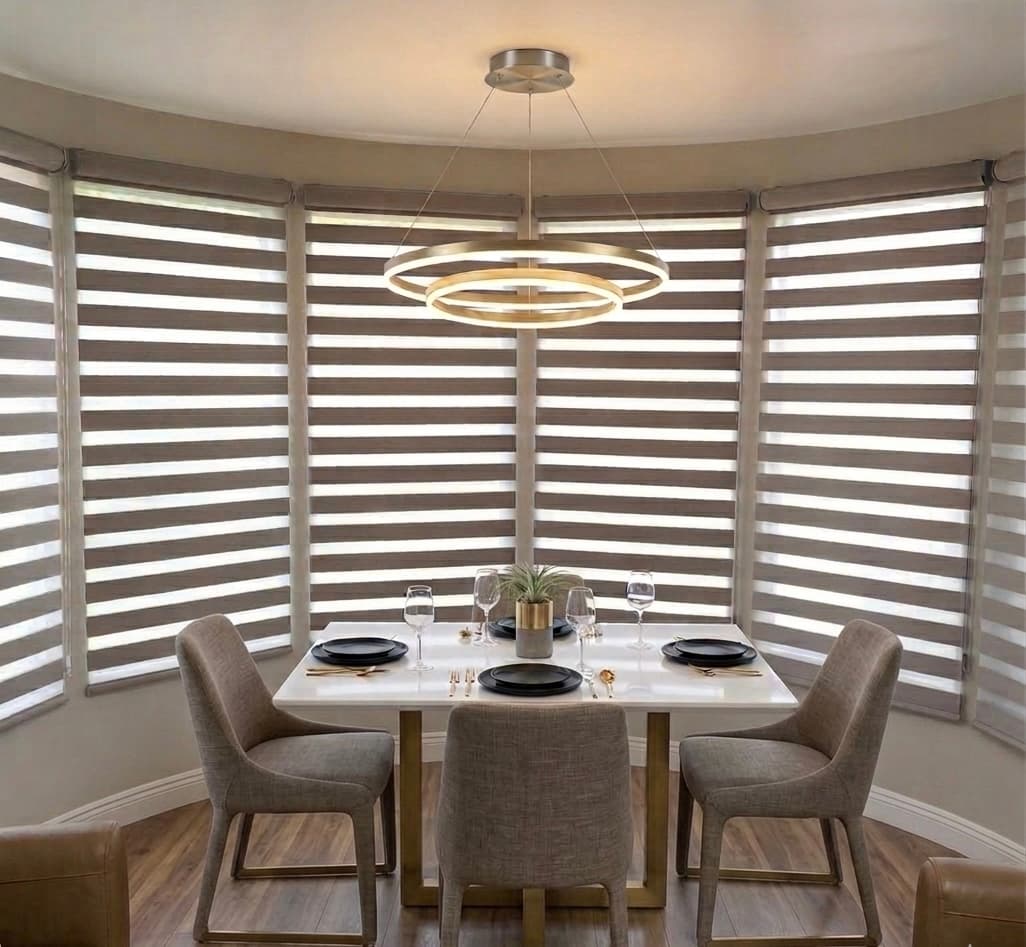
Picture a roller shade whose fabric is woven in horizontal stripes, alternating a see-through sheer band with an opaque solid band, and then doubled over itself in a continuous loop. That loop is the whole product. Because two layers of the banded fabric hang in front of each other, the stripes can align (sheer over sheer, light pours through in bands) or offset (solid over sheer, the window closes up). The name comes from the striping; the industry also sells them as dual shades, day-and-night shades, or transitional shades, all the same thing.
How the mechanism works
The engineering is almost disappointing in its simplicity, which is exactly what you want in something operated daily. The fabric loop runs around a roller tube at the top and a weighted rail at the bottom. Turning the tube (by chain, cordless spring, or motor) slides the front layer past the back layer, shifting the band alignment through its positions. Stop anywhere in between and the shade holds. Keep turning and the whole loop rolls up like any roller shade, clearing the glass completely. No cords thread through the fabric, no slats bend, and the failure modes that plague corded romans and cheap venetians simply don't exist here.
Zebra vs roller vs roman, honestly
| Zebra shade | Roller shade | Roman shade | |
|---|---|---|---|
| Light control | Adjustable in bands, view to private, without lifting | Fixed by fabric choice; adjust by raising | Fixed by fabric and lining; adjust by raising |
| The look | Modern, tailored, banded | Minimal, disappears into the room | Soft, warm, drapery-like folds |
| True blackout | Only with blackout fabric, ideally outside mount | Yes, with blackout fabric and side channels | Yes, with blackout lining |
| Best rooms | Living rooms, offices, street-facing rooms | Media rooms, minimalist spaces, everywhere on a budget | Traditional rooms, bedrooms, anywhere warmth matters |
| Motorization | Excellent candidate | Excellent candidate | Good, with weight limits |
The short version: zebras win when you adjust light many times a day, rollers win on price and invisibility, and romans win on warmth and character. A lot of our LA projects use two of the three in different rooms of the same house, which is the correct answer more often than any single category.
Light filtering vs blackout
Light-filtering zebras use a translucent solid band; even fully closed, the room keeps a soft glow, which is the point in living spaces and the problem in bedrooms. Blackout zebras weave the solid bands opaque, so the closed position genuinely darkens the room, with only the edge gaps of an inside mount leaking light. Our rule from years of bedroom installs: if sleep is the job, choose the blackout fabric and an outside mount, and if total darkness is the job (shift workers, screening rooms), layer lined drapery over it and end the discussion permanently.
Best rooms for zebra shades
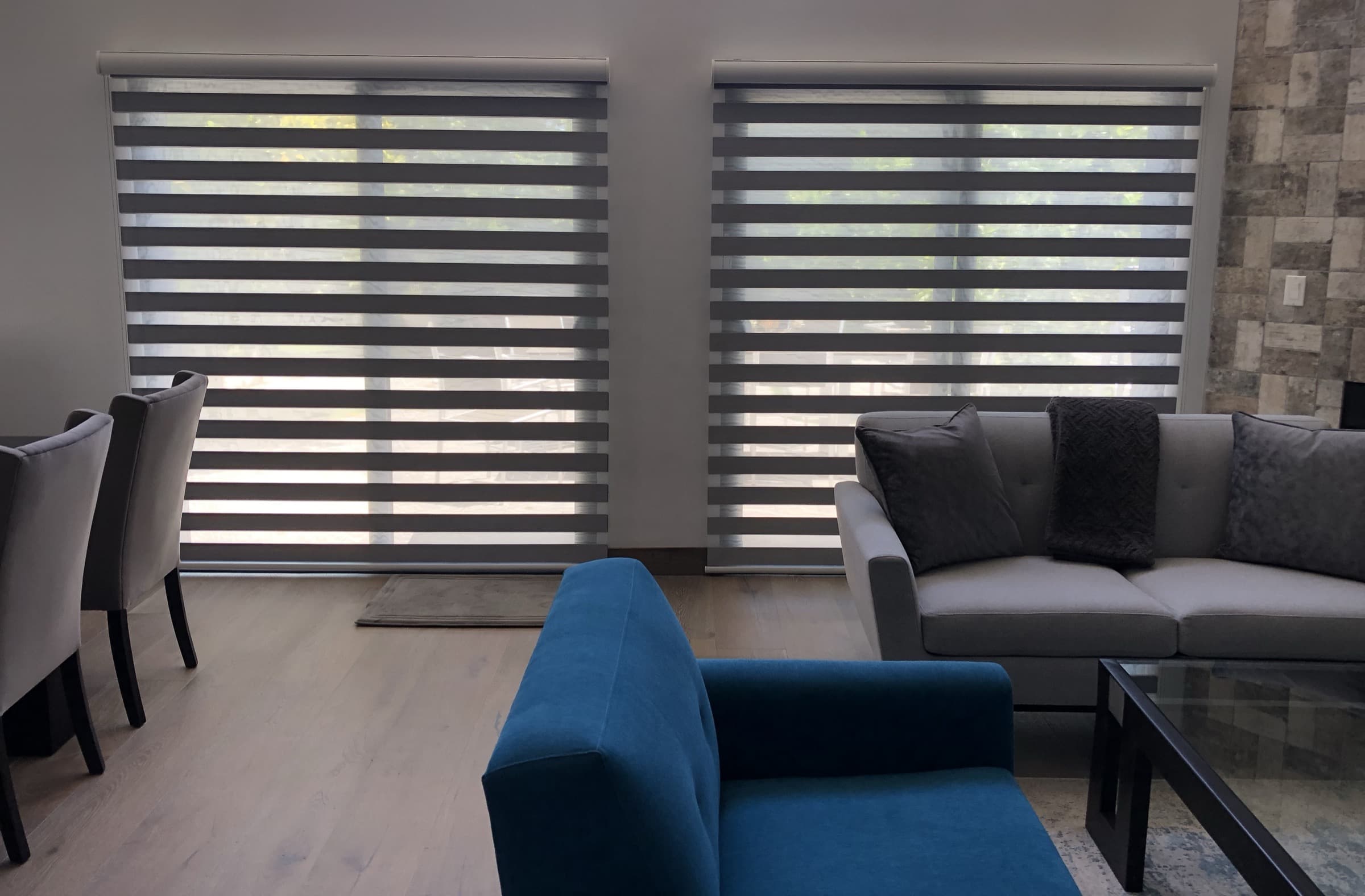
Zebras earn their keep in rooms where the light changes jobs during the day. Living rooms are the classic case: view in the morning, glare control mid-afternoon, privacy at dusk, all without touching the lift. Home offices are close behind, because screen glare moves with the sun and the band adjustment tracks it in seconds. Street-facing rooms love them for the privacy-with-daylight trick, and kitchens take them well where a fabric roman would live too close to the stove.
Where they're the wrong call: bedrooms, unless you choose the blackout fabric deliberately; deliberately traditional rooms, where the banded geometry argues with the architecture and a roman belongs instead; and bathrooms with direct shower spray, where a moisture-rated roller is the durable answer. A product this photogenic gets recommended for everything, and it shouldn't be.
Choosing fabric density and color
Within the light-filtering family, fabrics vary meaningfully in openness. Denser weaves read more solid, give more daytime privacy, and glow less; open weaves keep more view through the sheer bands and light the room more generously. Color plays differently than in drapery: light fabrics brighten but show shadowing from the bands behind, while mid-tones and warm grays hide the double-layer structure and photograph cleanest. Band height matters too; wider bands suit taller windows and read calmer, narrower bands suit smaller panes. This is exactly the decision swatches exist for, held against your window at the hours the room gets used.
Chain, cordless, or motor
The lift decision outlasts the fabric one. Continuous-loop chain is the budget default and fine in adult-only rooms, but every chain is a consideration wherever children live; current safety standards push hard toward cordless for good reason. Cordless spring lifts cost a bit more, operate with a hand on the bottom rail, and remove the safety question entirely. Motors remove the reaching too, and on zebras specifically they add something chains can't: precise, repeatable band alignment, the same afternoon position every day at the same hour. Homes with kids, tall glass, or more than three zebras in a row should start the conversation at cordless and let the motor argue for itself.
What they cost, stock vs custom
Zebra shades span one of the widest price ranges in the category. Stock sizes from big-box retailers are genuinely cheap, and at that price the corners cut are visible ones: bands that never quite align, edges that ripple within a year, mechanisms that drift out of position. Custom costs more and buys exact sizing (which is what keeps bands parallel to your sill), better fabric density, cordless or motorized operation, and an installation that's square to the world. We quote after a free measurement so the number reflects your windows, not a configurator's fantasy; the honest framing is that custom zebras sit well below custom drapery and somewhat above custom rollers.
Motorization
Zebras and motors are a natural pair: the loop is light, the tube is standard, and the fine positioning that makes zebras useful is exactly what a motor does better than a hand. We install Somfy and Rollease Acmeda systems, battery or hardwired, controlled from a remote, wall switch, app, or the smart home platform you already run. The practical wins are tall glass, banks of multiple shades moving together, and schedules: shades that close themselves against the western sun at 3pm are the kind of automation people actually keep using. The full local picture is on our motorized shades page.
Common problems and how to avoid them
Nearly every zebra complaint we're called to fix traces to one of four causes. Wrong size: an inside mount measured casually leaves fat light gaps or a shade that rubs its frame; measure the opening at three points and use the narrowest, or have it done professionally. Cheap fabric: low-density weaves sag between bands and never hang straight, and no adjustment fixes a fabric problem. Wrong expectations: a light-filtering zebra bought for a bedroom reads as a defect even though it's performing as designed; that's a selection error, not a product one. And chain-versus-cordless chosen thoughtlessly: homes with small children should treat cordless or motorized as the default, full stop. If you're measuring yourself, the measuring guide covers the inside-mount rules that matter here.
Inside or outside mount
Inside mount is the tailored look: the shade lives within the opening, shows off trim, and needs about 2 inches of flat depth plus a genuinely square opening, since the banded pattern advertises any tilt. Outside mount covers the frame, kills the edge light gaps, forgives crooked 1920s openings, and is mandatory for anything approaching blackout performance. Our default in older LA housing is outside mount unless the trim deserves the spotlight and the opening measures true; in newer construction, inside mount usually wins on looks.
Frequently asked questions
What are zebra shades?
Zebra shades are roller shades made from a continuous loop of fabric woven in alternating horizontal bands: one band sheer, the next solid, repeating down the shade. Because the fabric is doubled over itself, the bands overlap, and rolling the shade shifts how they align. Line the sheer bands up and light comes through in soft stripes; offset them so solids overlap sheers and the window goes private. One shade covers the range a roller and a sheer used to need two products for.
How do zebra shades work?
The mechanism is a standard roller tube; the trick is entirely in the fabric loop. As the tube turns, the front and back layers of the loop slide past each other, changing which bands overlap. A chain, a cordless spring, or a motor turns the tube, and stopping it at different points gives you open view, striped glow, or full coverage. There are no slats, no strings through the fabric, nothing to tangle: mechanically it's as simple as shades get.
Are zebra shades blackout?
A standard zebra shade is not, and any retailer telling you otherwise is rounding up. Even with solid bands fully overlapped, a normal zebra's sheer weave passes a soft glow, which most rooms find pleasant and bedrooms may not. Blackout zebra fabrics close that gap substantially: the solid bands are opaque and the alignment seals the striping, though edge gaps on an inside mount still leak a little. For true darkness, pair a blackout zebra with an outside mount, or layer drapery over it.
Are zebra shades in style?
They've moved from novelty to mainstream over the past several years, and the reason is practical rather than fashionable: they solve the light-versus-privacy trade cleanly and look tailored doing it. The banded pattern reads modern, which suits LA's contemporary and mid-century stock especially well. In deliberately traditional rooms a roman shade still usually wins on character, which is the honest answer a trend piece won't give you.
How much do zebra shades cost?
Stock-size zebra shades from big-box retailers are among the cheapest shades sold, and custom zebra shades cost meaningfully more, with fabric quality, exact sizing, and motorization driving the difference. Cheap zebras show their price quickly: bands that don't align evenly, fabric that ripples at the edges, mechanisms that drift. We quote custom zebras against your actual windows after a free measurement, so the number you get is real and includes installation.
How do I clean zebra shades?
Gently and dry, as a rule. Vacuum with the brush attachment on low, working across the bands rather than down, and dust the headrail while you're there. Spots get a barely damp white cloth and patience; soaking the fabric can ripple the bands and distort the alignment that makes the shade work. Skip harsh cleaners entirely. The good news is that the tight weave sheds dust better than most fabric treatments, so a monthly pass keeps them sharp.
How do I measure for zebra shades?
Same rules as any shade. For an inside mount, measure the opening's width at top, middle, and bottom and give the workroom the narrowest, plus the height at left, center, and right using the longest; check for about 2 inches of flat mounting depth. For an outside mount, decide coverage rather than measuring the opening: 2 to 3 inches past the frame each side and above. Our full measuring guide walks through every step with diagrams.
Can zebra shades be motorized?
Yes, and they're one of the best candidates for it because the fabric loop is light and the tube is standard. We motorize zebras with Somfy and Rollease Acmeda systems, controlled by remote, wall switch, phone app, or a smart home system. Motorization earns its cost fastest on tall or wide glass, hard-to-reach windows, and rooms where you'd otherwise adjust the shade several times a day chasing the light.
Do zebra shades provide privacy at night?
In the closed position, yes for silhouettes and shapes; the room reads as private from the street. But like all sheer-adjacent fabrics, a standard zebra with interior lights blazing at night can show more shadow detail up close than people expect. If nighttime privacy is the priority (bedrooms, bathrooms, ground-floor street-facing rooms), choose the blackout zebra fabric, which closes fully opaque and ends the question.
What is the difference between zebra blinds and zebra shades?
Nothing, in practice. "Blinds" technically means slatted treatments (wood, faux wood, aluminum) while "shades" means fabric ones, which makes zebra a shade, but retailers and homeowners use both names for the same product. You'll also see them sold as dual shades, day-and-night shades, or transitional shades. If it's a rolling loop of alternating sheer and solid fabric bands, it's the product this guide is about.
Getting them made
Every zebra shade we sell is custom-cut to the window, in fabrics we'll put in your hands before you decide, with cordless and motorized options on all of it.